THANK YOU FOR SUBSCRIBING
Weekly Brief
Be first to read the latest tech news, Industry Leader's Insights, and CIO interviews of medium and large enterprises exclusively from Healthcare Tech Outlook


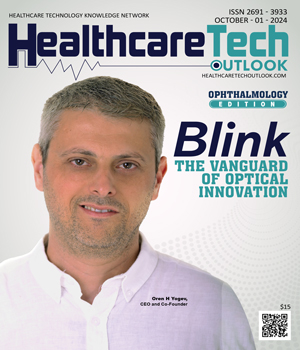
 Oren H Yogev, CEO and Co-Founder, Blink
The technology is set to revolutionize the optical industry, traditionally burdened by complex eye sight measurement and testing procedures. Opticians have long sought more efficient and precise methods, while customers want a faster process for corrective lens prescriptions. Blink’s solution skillfully combines the needed precision and speed.
“We are addressing the challenges opticians and end users face with manual, cumbersome processes. Using AI technology, we make eye tests highly precise and extremely fast,” says Oren H Yogev, CEO and Co-Founder.
Capitalizing on a Kaleidoscope of Data
Blink’s AI model takes a data-driven approach to addressing the distinct requirements of users. The model is fed with data from more than 12 million individuals with diverse visual aberrations, performing daily tasks under various conditions, such as using a screen, driving or reading. It includes individuals wearing glasses, contact lenses or without any corrective eyewear. To ensure that the technology serves a diverse global population, the data represents individuals across demographics, including different ages, genders, ethnicities and geographical locations.
By exposing the models to this extensive dataset, AI learns to recognize and interpret nuanced details. This iterative process enhances the software’s ability to identify the exact measurements needed for individuals with similar aberrations, improving the precision of vision assessments.
The non-intrusive technology works on any camera-enabled device and allows opticians to easily conduct tests. The measurements obtained are so precise, greatly enhancing the overall user experience.
“Our digital tools and a huge database give opticians better insights on what optimal vision correction should look like,” says Gilad Drozdov, co-founder and chief technology officer.
Blink collects the data through numerous partners in ophthalmology, including those in vision correction and treatment devices, with a strong emphasis on compliance with General Data Protection Regulation (GDPR) regulations. All data is handled with strict adherence to privacy standards and participants are fully informed about the nature of their involvement and the algorithms being developed.
Delighting Opticians and Customers Alike
Unlike traditional hardware-dependent systems, Blink’s software-driven approach makes it an efficient and cost-effective solution for opticians. Many still rely on outdated devices that yield inaccurate measurements of crucial metrics like Pupil Distance (PD). It can lead to errors in lens design and incorrect prescriptions. It’s a real problem for patients and undermines the reputation and finances of opticians who need to accept returns of custom products that cannot be resold.
Blink’s technology accurately detects PD, reducing the likelihood of product returns. The technology seamlessly integrates with devices running on any operating system, eliminating the financial burden of maintaining larger spaces for bulky equipment.
Blink drastically reduces the time required for testing to just a few minutes. Integrated gamification elements in the software keep impatient children engaged, offering a solution for parents seeking to help their little ones.
The simulation capability is also integrated into its virtual try-on (VTO) technology, which assist users in selecting eyewear designs that perfectly complement their face shape. 3D simulations offer a more realistic preview, helping them visualize how they would appear from various angles. It also lets eye care professionals precisely adjust frames without physically measuring the client’s face.
“Our idea is to revolutionize the user experience while also helping opticians select the correct products to help their customers improve their eyesight,” says Yogev.
Secured by numerous patents, the technology is already deployed in thousands of optical stores worldwide. It is particularly beneficial in regions with limited access to eye care professionals, such as Africa and Asia. The handheld devices make eye care more accessible, enabling pediatricians, ophthalmologists and opticians to provide essential services in underserved areas.

Perfecting User Satisfaction
Customer satisfaction is always Blink’s top priority. It employs innovative tools like holographic and 3D displays to achieve this. These simulation tools are particularly beneficial for complex prescriptions, such as progressive lenses, where customers often struggle to visualize the final outcome. By allowing them to experience a simulated view, the tools help them manage their expectations.

Our idea is to revolutionize the user experience while also helping opticians select the correct products to help their customers improve their eyesight

The simulation capability is also integrated into its virtual try-on (VTO) technology, which assist users in selecting eyewear designs that perfectly complement their face shape. 3D simulations offer a more realistic preview, helping them visualize how they would appear from various angles. It also lets eye care professionals precisely adjust frames without physically measuring the client’s face.
The technology is also leveraged to provide versatile solutions for treating eye conditions like lazy eye. Traditionally, treatment involves covering the stronger eye with a patch to strengthen the weaker eye. Blink’s 3D display delivers different video streams to each eye, blurring one eye more or adjusting the visual cues to train the weaker eye. This approach provides a more comfortable and effective solution.
The technology can even replace 3D glasses. The display precisely tracks the location of the user’s eyes and ensures that the right video stream is sent to the right eye and the left stream to the left eye, resulting in an immersive holographic experience.
Pushing the Limits of Optical
Crossing Industry Boundaries
Innovation In the coming years, Blink aims to focus on modernizing refraction. Using holographic and light field displays, it aims to offer a more realistic and natural visual experience. The technologies will reduce costs and enable eye care professionals to conduct even faster and more precise measurements.
Plans are also underway to extend the accessibility of eye tracking technology to personal devices. Individuals will be able to take measurements and order glasses using their smartphones and tablets, eliminating the need to visit an optician. Opticians gain the opportunity for off-office activation, broadening their ability to reach a wider audience.
This integration will aid users further by enabling continuous vision health tracking to look for potential eye disorders. While examinations like ocular image analysis have provided for significant progress in detecting eye disorders, understanding eye behavior in varied settings is beyond the capability of physical scans. Blink’s technology can provide a holistic understanding of vision health and detect eye conditions that cannot be caught under scans.
-
We are addressing the challenges opticians and end users face with manual, cumbersome processes. using ai technology, we make eye tests highly precise and extremely fast
Crossing Industry Boundaries
Powered by the dedicated efforts of its R&D team, Blink is expanding its reach into diverse sectors, including entertainment, automotive and gaming. One of its major technologies under development is vision-correcting display (VCD), which allows users to read and view content from a screen without wearing their corrective lenses. Displays with this technology will automatically detect the user’s eye measurements and adjust.
Blink has formed partnerships within the automotive industry to integrate VCD technology into vehicles. Crucial eye behavioral metrics will help monitor the visual attention of drivers and provide safety measures for preventing accidents. The technology can also facilitate hands-free control of infotainment systems and interaction with head-up displays.
Gaze tracking technology is set to play a crucial role in meeting the anticipated demands in digital vision correction. Blink is introducing the technology to Apple, Google and Microsoft, with the aim of integrating the capability into their operating systems.
Consistently pioneering innovations in the eye care industry, Blink is leading the way in developing ‘A-Eye’ technology for the modern world. Through the trailblazing technology, it is racing toward unlocking all optical possibilities human eyes are capable of experiencing.

Company
Blink
Management
Oren H Yogev, CEO and Co-Founder, Gilad Drozdov, Co-Founder and Chief Technology Officer, Blink
Description
Blink is a software start-up company pioneering AI-driven eye tracking solutions for opticians to assess and correct vision issues accurately. The software revolutionizes the industry with cost-effective, non-intrusive technology, prioritizing user comfort and affordability for opticians.