THANK YOU FOR SUBSCRIBING
Weekly Brief
Be first to read the latest tech news, Industry Leader's Insights, and CIO interviews of medium and large enterprises exclusively from Healthcare Tech Outlook


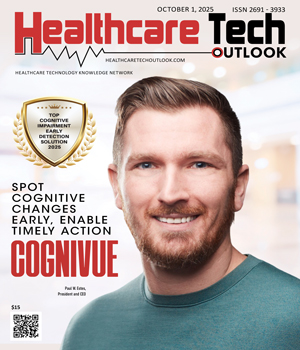
 Paul W. Estes, President and CEO, Cognivue
This is a pattern seen far too often in clinics nationwide. People show the first signs of mild cognitive impairment (MCI), a prodromal stage where decline is evident, but daily life still feels manageable. Yet research shows that up to 80 percent of these cases go undetected in routine practice because current tools rely on lengthy interviews and outdated paper-and-pencil tests.
What has been missing is a practical, patient-friendly tool that makes early detection possible—until now.
 James E. Galvin, MD, MPH, Chief Scientific Officer, Cognivue
“We’re here to break down systemic barriers such as patient reluctance, limited clinician time, and lack of formal policy guidance, and ultimately transform brain health screening into a routine, essential standard of care, supported by ongoing innovation and trusted by clinicians, patients, and families alike,” says James E. Galvin, MD, MPH, chief scientific officer, driving the breakthrough in cognitive care at Cognivue.
The Devices Behind the Science
At its core, the company delivers this science through two precision cognitive assessment devices designed based on adaptive psychophysics: Cognivue Clarity® and Cognivue Thrive®.
While patients are in allied health environments such as pharmacies, audiology clinics, or optometry practices, Cognivue Thrive® serves as a rapid five-minute screening tool to detect potential cognitive impairment. If the screening shows no significant concerns, patients continue with routine care; but if it indicates possible issues, they are referred to their Primary Care Physician for further evaluation. While patients are in primary care or other specialty environments, Cognivue Clarity® serves as a more advanced, ten-minute, ten-test platform which provides additional insight alongside a full neurological exam, offering deeper data points, richer reporting, and broader diagnostic support that help physicians arrive at more accurate differential diagnoses.
Cognivue Clarity® follows a simple test design where instead of static questions, it continuously adjusts the difficulty in real time based on the individual’s performance. If a person is performing well, the tasks become progressively harder until they can no longer complete them, presenting an accurate measure of their performance threshold.
For Early Intervention with Quick and Clear Insights
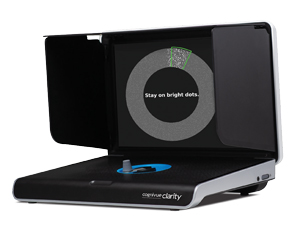
 This level of sophistication is achieved without adding burden, as the device is fully self-contained and intentionally simple for patients to use. The only control is the CogniWheel®, a dial that moves only clockwise or counterclockwise, like a flywheel. The patient simply turns the knob when prompted, watching the target shift on the screen in response. If they can move it to the designated position, they succeed. No complicated steps or prior tech expertise required; instead, just a straightforward task designed for anyone to use.
Behind this simplicity lies a complex adaptive intelligence. The device automatically adjusts to the individual’s baseline abilities. For example, if someone has arthritis and moves more slowly than a younger person, the system accounts for this difference, ensuring that slower motor function does not unfairly affect cognitive scoring.
And the intelligence runs deeper. From a single session with Cognivue Clarity®, the device captures over 130,000 data points, not just the final score but also rich metadata and para-data from how the user engages with each task. By analyzing response tracings, clinicians can verify the validity of the test, detect patterns that may indicate changes over time, and gain deeper insight into a patient’s cognitive processes.

We’ll be presenting our latest work on this at the upcoming 2025 clinical trials in Alzheimer’s disease (CTAD) conference, showcasing how cognivue clarity® can be integrated into clinical practice for quick, accurate early detection

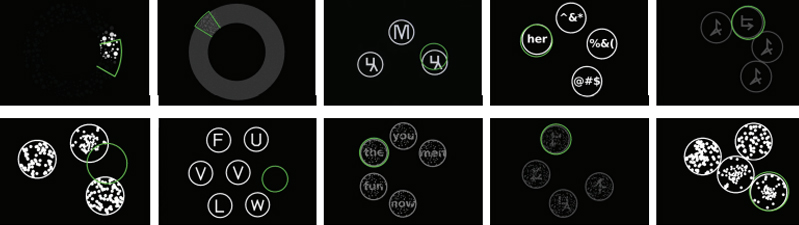
The assessment produces a global score composed of ten subtests, each targeting specific cognitive domains. Two are adaptive tests, adaptive motor control and visual salience, which establish a patient’s baseline motor and visual abilities. This baseline then calibrates the stimuli for the rest of the assessment, minimizing bias by avoiding external comparisons and adapting to each individual’s capabilities. Four are discrimination tests: letter recognition from the 26-letter alphabet and identification of common three-letter words from a set of 30 for vocabulary assessment, shape detection, and motion detection from moving dot patterns.
Discrimination task is followed by a working memory test using n-back assessments, starting with one-back and progressively adding interference until the participant can no longer continue. These working memory tasks measure encoding, recall, and overall working memory capacity.
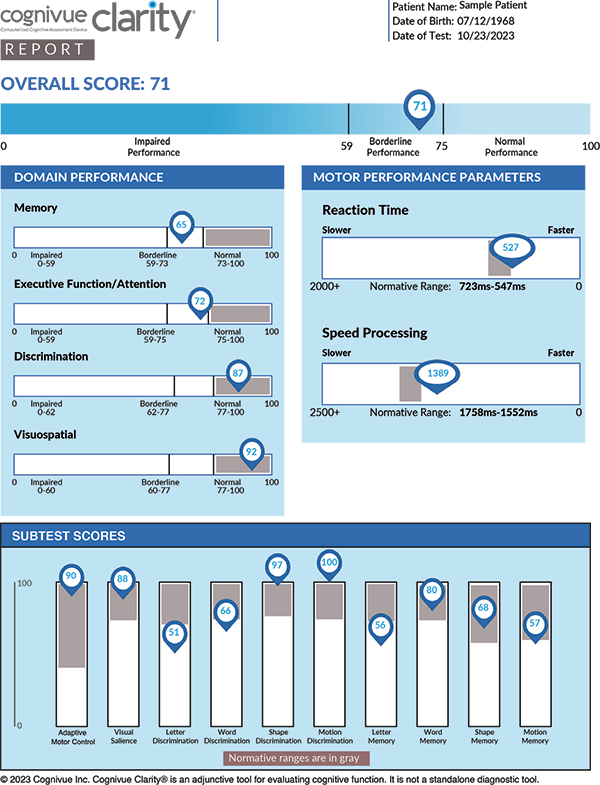
The device is further designed for flexibility and accessibility. While it can be connected to the internet for software updates or data transfer, it does not require internet access to function. Tests can be conducted anywhere, with instant generation of a three-page report encompassing summary scores, response tracings and detailed breakdowns of each subtest.
Cognivue’s adaptive tests can also target evolutionarily conserved cognitive domains, providing clinicians with a valuable tool to identify cognitive impairment and estimate the likelihood of amyloid accumulation—an early marker of Alzheimer’s disease—all without the need for invasive or costly procedures.
-
We’re here to break down systemic barriers such as patient reluctance, limited clinician time, and lack of formal policy guidance, and ultimately transform brain health performance into a routine, essential standard of care, supported by ongoing innovation and trusted by clinicians, patients, and families alike
The device is further designed for flexibility and accessibility. While it can be connected to the internet for software updates or data transfer, it does not require internet access to function. Tests can be conducted anywhere, with instant generation of a three-page report encompassing summary scores, response tracings and detailed breakdowns of each subtest.
Praised for Simplicity, Trusted for Reliability
The device has earned consistent praise from patients for its simplicity and from clinicians for its reliability.
“Unlike formal interviews or paper-and-pencil tests, the test experience feels simple and user-friendly for patients, while for doctors and clinicians it translates into meaningful time savings,” says Paul W. Estes, president and CEO.
The self-administered assessment doesn’t need clinicians to be in the room to guide patients. They simply have to enter the patient’s ID and age, then step away while the patient completes the assessment. In about ten minutes, the test is done, and an instantaneous report is generated, providing rich data and detailed reporting. This setup frees up valuable clinician and staff time while delivering deeper insights into cognitive performance, making it ideal even for busy clinical settings.
Achieving that simplicity and reliability took years of research, testing, and fine-tuning.
Foundations Laid and the Horizon Ahead
Cognivue’s story is one of persistence and bold vision: turning subtle, overlooked signs of decline into clear, actionable insights. Born from NIH-funded research in the early 2000s, it secured FDA clearance in 2015 and quickly delivered a first-of-its-kind, self-guided device calibrated to each person’s abilities. A 2018 redesign made it portable and intuitive, fueling adoption across primary care, neurology, and allied health. By 2019, it was integrated into pharmacy, audiology, and optometry workflows. In 2020, large-scale studies and peer-reviewed publications confirmed its reliability, cementing Cognivue as a credible, cost-effective new standard in cognitive health.
 From there, innovation came in rapid fire: richer data capture in 2022, age-adjusted normative scoring in 2023, and the Clarity Report in 2024, giving clinicians a sharper view into cognitive domains, subtests, and reaction times, making results even more actionable.
The research has been equally compelling. The FOCUS Study, published last year, confirmed Clarity’s psychometric strength across adults 18 to 85 from diverse racial, ethnic, and educational backgrounds. It showed high reliability, minimal practice effects, and outcomes that tracked closely with RBANS, a gold-standard neuropsychological test. In short: fast, fair, and accurate.
The Bio-Hermes Study, conducted by the Global Alzheimer’s Platform Foundation (GAP), raised the bar further. In head-to-head comparisons, Clarity outperformed paper-based tests in detecting mild cognitive impairment and showed sensitivity to amyloid. Digging deeper, researchers discovered that Cognivue can detect cognitive impairment, identify individuals likely to be amyloid-positive, and uniquely recognize preclinical Alzheimer’s disease—people who appear cognitively normal but are already at higher risk—making it the only cognitive assessment shown to do so and distinct from all others.
That insight sparked the Cognitive Amyloid Risk Measure (CARM). By blending those subtests with patient age in a machine learning model, CARM predicts the likelihood of an abnormal amyloid PET scan, essentially spotting risk years before symptoms fully show. Alongside it, Cognivue launched a research package combining purpose-built hardware, secure data, advanced reporting, and expert support, making top-tier cognitive research more accessible than ever.
“We’ll be presenting our latest work on this at the upcoming 2025 Clinical Trials in Alzheimer’s Disease (CTAD) Conference, showcasing how Cognivue Clarity® can be integrated into clinical practice for quick, accurate early detection,” says Galvin.
And this is just the start of what Cognivue can do, with more breakthroughs on the horizon that promise to expand the reach of early detection, empower clinicians, and transform the way we understand and treat cognitive health.
With innovations like the Cognitive Amyloid Risk Measure and ongoing neurological research, the company continues to expand its early detection of age-related cognitive changes into dementias and a broad range of other CNS conditions. Its portability and adaptability mean it can deliver critical insights anywhere, from clinics to remote communities, by bringing early detection and intervention within reach for all.
Company
Cognivue
Management
Paul W. Estes, President and CEO, James E. Galvin, MD, MPH, Chief Scientific Officer, Cognivue
Description
Cognivue transforms cognitive care with FDA-cleared, self-guided assessments that detect early impairment and Alzheimer’s risk in just ten minutes. Designed based on adaptive psychophysics, the technology empowers clinicians with actionable insights, enabling timely intervention, treatment, and research, delivering accessible, precise brain health screening from clinics to remote communities worldwide.