


THANK YOU FOR SUBSCRIBING
Weekly Brief
Be first to read the latest tech news, Industry Leader's Insights, and CIO interviews of medium and large enterprises exclusively from Healthcare Tech Outlook
Healthcare Tech Outlook: Specials Magazine
Tranzformiq
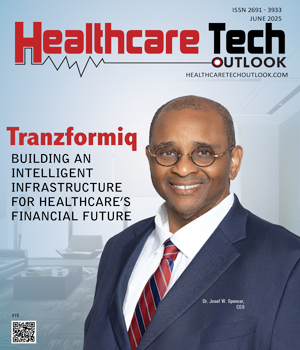
Building an Intelligent Infrastructure for Healthcare’s Financial Future
After thirty years leading in healthcare IT, Dr. Josef W. Spencer saw his hospital system—once a fierce competitor—fall to financial pressures and an inevitable takeover. Instead of walking away, he turned that hard-earned lesson into Tranzformiq: a bold new force building the intelligent, AI-powered infrastructure that addresses the full spectrum of revenue cycle management and patient care optimization. “We are building an intelligent infrastructure that will redefine healthcare finances itself. Our aim is to create a future where data-driven systems support sustainability, precision and smarter decision-making across the entire healthcare ecosystem,” says Dr. Spencer, CEO. THE PRESENT-DAY CONUNDRUM Today, hospitals operate under a system that provides critical care to patients first and then, 60 days later, begin the slow and complicated process of seeking reimbursement from insurance companies. Registration teams, clinicians and finance departments are left scrambling to interpret complex insurance contract rules, often with limited visibility, resulting in costly errors. Besides, delayed reimbursements and denials from the payers often exert significant strain on cash flow and easily snowball to affect the overall financial stability. Tranzformiq is en route to circumnavigate these inherent complexities and close the door to denials through its latest solution—RIQ. By using artificial intelligence and machine learning, this platform is gearing up to help independent health systems across the U.S. improve their financial posture. R-IQ: The Future Of Revenue Cycle Intelligence Tranzformiq’s patent-pending, AI-powered platform is capable of bringing greater accuracy, efficiency and predictability to the reimbursement process. Rather than the traditional method of static rule engines and reactive workflows, R-IQ functions as a proactive, intelligent system that transforms how healthcare organizations manage revenue cycles. The platform supports activities across a full 180-degree span of the revenue cycle—from patient scheduling and registration, through clinical care, discharge and into post-discharge monitoring. The platform is trained on 26 billion historical claims data and payer contract terms, with the goal of offering real-time guidance at the point of care, particularly during patient scheduling and intake. This enables administrative and clinical staff to effortlessly identify documentation or compliance gaps early.
The company began with a bold vision: To become the global healthcare communication platform, oriented around the primary diagnostic tool- radiology. TeleRay works to make virtual healthcare more accessible, secure, and user-friendly. Backed by more than 150 years of combined expertise, TeleRay’s founding team sought to address long-standing pain points in healthcare technology—chiefly the fragmentation and inefficiency caused by siloed platforms. What emerged is a solution that streamlines providers’ operations and enhances patients’ overall care experience, while delivering the most value. Simplicity and Accessibility at Its Core What makes TeleRay stand out is not just its functionality but also its simplicity. The platform can adapt to existing room and hardware configurations with footwall TVs, carts, whiteboards and other systems. This ability eliminates additional hardware or complex software installations, making it accessible across various devices. Providers can quickly engage with the platform, whether on a mobile phone, tablet, or desktop. The ease of use allows healthcare professionals to focus on delivering care without being bogged down by the technical challenges often accompanying virtual care and telehealth solutions. TeleRay adds to clinical communication through its live modality streaming capabilities. Providers can conduct high-definition video consultations and share crucial medical images from ultrasound, fluoroscopy, endoscopy, MR, CT, in real-time, all within the same platform. This integration of video conferencing with live image streaming facilitates better collaboration between specialists and general practitioners, enabling them to work together seamlessly in a single consultation. In rural healthcare settings, specialists can remotely guide radiology procedures, ensuring proper patient and probe positioning while offering real-time advice. Placing clinicians virtually in the room with access to data is the differentiator for TeleRay. Building a Safer, Smarter Future for Telehealth Where TeleRay builds upon its workflow capabilities is in its AI-driven options. Ai features help with alerts, and critical notifications. The AI can prevent and detect falls, listen for sounds (infusion pumps, pule oximeter), coughing fits, and monitor aggression at all times ensuring safety for patients and clinicians. It is like having an extra set of eyes and ears right into the platform, ensuring that every session is secure and as insightful as possible. Other AI applications can scan for unscripted medications, telemetry, IV levels, and more. However, none of this matters without compliance and security. TeleRay knows that protecting patient data is non-negotiable. Its platform is fully HIPAA-compliant and powered by Microsoft Azure’s secure cloud infrastructure, along with their own proprietary private key encryption system, which is essentially unbreachable, giving everyone peace of mind. To back this up, TeleRay is the only company that offers a $2,000,000 breach policy to their users that is beyond the cybersecurity insurance. .

Healthcare Artificial Intelligence Solutions Provider 2025

Barti Software
Lens to Legacy: Bridging Innovation and Efficiency in Eye Care
Colton Calandrella, CEO and Co-founder
For independent eye care professionals— optometrists and ophthalmologists—the daily grind is often plagued by outdated systems, clunky software, and endless paperwork. These inefficiencies drain their time and detract from what matters most: delivering exceptional care to their patients. Finding software that truly meets their needs without adding to their frustration feels nearly impossible. But what if it didn’t have to be this way? Imagine a world where scheduling appointments is seamless, forms are completed digitally before a patient arrives, and communication between doctors and patients is simple and intuitive. With cutting-edge software, eye care professionals could focus entirely on their patients, no longer bogged down by antiquated systems. This vision isn’t far off—it’s here, thanks to Barti Software, a transformative platform reimagining the world of eye care. The company has reinvented the patient journey, starting with a sleek, user-friendly website where appointments can be booked online in seconds. Patients can fill out digital intake forms on their phones, saving everyone time, and receive helpful text reminders so they never miss an appointment. For practice staff, Barti transforms workflows by replacing multiple outdated tools with one intuitive platform. From the moment a patient arrives, everything runs seamlessly within Barti. Staff can conduct exams, place optical orders, manage inventory, process payments, and handle insurance claims—all with fewer clicks and minimal hassle. “We take pride in being the only practice management software for vision care that offers advanced AI capabilities. Coupled with modern communication tools like VoiP phones built-in, Barti creates a frictionless experience that benefits both patients and practices alike,” says Colton Calandrella, CEO and co-founder of Barti.
Telemedicine & Telehealth

Navigating Emerging Challenges in Healthcare: Transformative Solutions and Patient-Centric Approaches
Sandi Wagner, Virtual Services Director, Saint Francis Health System
Telemedicine & Telehealth

Forming a Population Health or Value-Based Care Technology Team? Here are Some Considerations!
Alexander Koster, AVP Value Transformation, Nemours
Telemedicine & Telehealth

Cultivating the Future of Healthcare: Integrating AI with Empathy
Bill Dailey, Chief Medical Information Officer, Golden Valley Memorial Healthcare
Telemedicine & Telehealth

Developing and Scaling a Clinical Generative AI Product across Providence
Jessica Schlicher, Chief Medical Officer, Virtual Care and Digital Health, Providence
Telemedicine & Telehealth

Virtual Care: The Solution to Patient Access and Staffing Limitations
Abby Losinski, Director of Telehealth, St.Luke’s Health System

IN MY OPINION
Telemedicine & Telehealth
AI doesn't Always Know Better
Bridget Hough, Director of Academic and Executive Search, UCLA Health

LAST WORD
Telemedicine & Telehealth
Intuition Enhanced:Clinical Instinct and AI Models
Nicole Beyrouthy, Associate Director, Data & Analytics Delivery, Cedars-Sinai
IN FOCUS

Elevating Healthcare Access: The Impact of Intelligent Virtual Solutions
Virtual care has become a strategic asset, using intelligent technologies to enhance patient engagement, streamline clinical workflows, and address privacy and access inequality issues.

AI-Powered Healthcare: Redefining Patient Experiences and Clinical Practices
AI enhances healthcare by improving diagnostics and personalizing treatments. It also addresses staffing shortages and faces challenges like data bias.
EDITORIAL
The Rise of Virtual AI-Driven Care
As healthcare moves beyond traditional clinical settings, the focus on accessible, patient-centered care is making virtual care platforms more essential than ever. At the same time, artificial intelligence (AI) is transforming the industry, enhancing diagnostics, streamlining workflows and supporting predictive decision-making. As organizations pursue smarter, faster and more cost-effective solutions, AI tools have become indispensable, supporting real-time insights, tailored treatments and greater operational precision. Together, virtual care platforms, AI technologies and data-driven strategies are creating a dynamic healthcare ecosystem defined by innovation, scalability and the push toward digitally connected, outcome-oriented care.
Robust virtual care platforms provide secure and reliable video conferencing, appointment scheduling and integration with EMRs, making it easy for providers and patients to collaborate remotely. These platforms are crucial in expanding access to healthcare, particularly for individuals in remote areas or with limited mobility.
Building on this digital foundation, AI is streamlining clinical workflows, improving diagnostic accuracy and enabling early interventions. From predictive analytics to intelligent triage, AI tools are empowering providers to deliver faster, more personalized care while addressing workforce and resource challenges. At the forefront of this shift are innovators developing scalable AI tools that integrate seamlessly with electronic health records and care delivery systems. Their innovations enhance clinical decision-making and optimize operations, helping healthcare organizations navigate the growing complexity of modern healthcare with agility and precision. Together, virtual platforms, AI tools and data-driven approaches are reshaping the future of care delivery.
In this edition of Healthcare Tech Outlook, we spotlight the leading companies specializing in virtual care platforms, AI-powered healthcare transformation and healthcare AI solutions. Thought leaders like Alexander Koster, AVP Value Transformation at Nemours, emphasize the importance of integrated tech teams and data-driven systems in advancing value-based care. Nicole Beyrouthy, associate director of data and analytics delivery at CedarsSinai, illustrates how predictive AI models, when paired with clinical intuition, elevate patient outcomes in high-demand settings. These voices reflect a market rapidly shifting toward intelligent, scalable and compassionate care— where data, insight and human empathy work together to shape the next chapter of healthcare delivery.
This edition highlights how virtual care, AI transformation and smart healthcare solutions are advancing efficiency, enabling personalized care and accelerating the shift toward data-driven, scalable and patient-centric healthcare systems.
