THANK YOU FOR SUBSCRIBING
Weekly Brief
Be first to read the latest tech news, Industry Leader's Insights, and CIO interviews of medium and large enterprises exclusively from Healthcare Tech Outlook


 Ethan Cohen, CEO
Rather than accept this gap, UH built its own solution.
The result was HemaLogiX™, a novel analytics platform that evaluates the appropriateness of every transfusion using patient-level variables and evidence-based guidelines. The platform proved so effective inside UH—cutting transfusions by 30–50 percent and generating $55 million in cumulative savings—that UH licensed the technology to a spin-out company, Hemaptics, making the innovation available to health systems nationwide.
“We started with a simple goal: give clinicians the kind of patient-specific insight that actually changes decisions,” says James L. Hill Jr. MD, MBA, CPE, FASA, FACHE, Chief Operating Officer, University Hospitals Parma Medical Center and a founding clinical leader of the project. “Once we saw how powerfully HemaLogiX improved practice at UH, it became clear that other hospitals could benefit in the same way.”
A Patient-Specific Approach Built for Clinical Reality
Traditional transfusion tools rely on static metrics and generic thresholds that miss the complexity of real-world decision-making. By contrast, HemaLogiX integrates more than 80 patient specific data points and applies UH’s proprietary Transfusion Appropriateness Algorithm (TAA) to analyze each transfusion across all four major blood components.
 James L. Hill Jr. MD, MBA, CPE, FASA, FACHE, Chief Operating Officer, University Hospitals Parma Medical Center and Jennifer Dawson, RN, Principal Advisor, System Resource Utilization, University Hospitals
“Clinicians trust data when it reflects their exact patient,” says Dr. Hill. “HemaLogiX provides that level of context, so the feedback is relevant and actionable.”
Driving Behavior Change Without Interrupting Workflow
One of the reasons HemaLogiX succeeds where other tools fall short is its fit with clinical workflow. Instead of forcing providers to change their practice, the platform illuminates patterns and opportunities that clinicians readily understand and respond to.
“We designed HemaLogiX to bring clarity to a process that’s historically been opaque,” says Ethan Cohen, CEO of Hemaptics. “When clinicians see patient-specific information presented objectively and transparently, they engage with it—and practice naturally improves.”
The platform’s daily, automated analyses surface priority opportunities and highlight trends over time, enabling leaders to hold meaningful, collaborative conversations with providers.
Proven Impact: Lower Cost, Less Waste and Decreased Risk
-
We started with a simple goal: give clinicians the kind of patient-specific insight that actually changes decisions. Once we saw how powerfully HemaLogiX improved practice at UH, it became clear that other hospitals could benefit in the same way.
Proven Impact: Lower Cost, Less Waste and Decreased Risk
UH system’s eight-year experience demonstrates the platform’s power:
• 30-50% reduction in transfusions
• $55 million cumulative savings
• 14 percent improved appropriateness
• No increase in adverse outcomes
• Reduced waste
Because transfusions cost 2.5–7 times their acquisition price, even modest improvements generate considerable savings. Every avoided transfusion represents not only a financial benefit, but a safer decision for the patient.
A Platform Built for the Future of Transfusion Management
Hemaptics continues to expand the vision of HemaLogiX, with future generations incorporating decision support at the point of care, broader analytics, and applicability to additional treatments. The company’s founding team reflects a blend of clinical, operational, and technical expertise—including transfusion medicine, anesthesiology, nursing, enterprise analytics, and healthcare software development.
“HemaLogiX gives hospitals the visibility they need to improve patient care,” says Jennifer Dawson, RN, Principal Advisor, System Resource Utilization, University Hospitals. “Every engagement becomes high-value, and every change is grounded in evidence.”
From a Local Challenge to a National Solution
What began as an internal innovation at University Hospitals has evolved into a scalable platform capable of reshaping transfusion management across the country. By transforming complex patient data into clear, actionable insight, Hemaptics is redefining how hospitals think about transfusion safety, cost, and practice variation.

Company
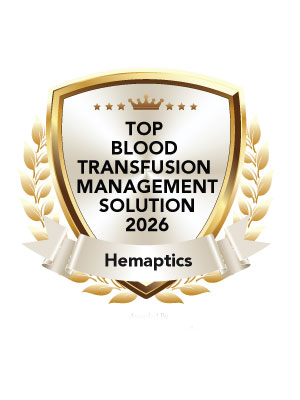
Hemaptics
Management
Ethan Cohen, CEO, James L. Hill Jr. MD, MBA, CPE, FASA, FACHE, Chief Operating Officer, University Hospitals Parma Medical Center and Jennifer Dawson, RN, Principal Advisor, System Resource Utilization, University Hospitals
Description
HemaLogiX™, developed by Hemaptics, is an EMR-integrated transfusion analytics platform incorporating more than 80 patient-specific details for every transfusion. Built through collaboration with University Hospitals of Cleveland, it transforms complex clinical data into clear, actionable insights that improve blood stewardship, strengthen patient safety, and reduce overall healthcare costs.