


THANK YOU FOR SUBSCRIBING
Weekly Brief
Be first to read the latest tech news, Industry Leader's Insights, and CIO interviews of medium and large enterprises exclusively from Healthcare Tech Outlook


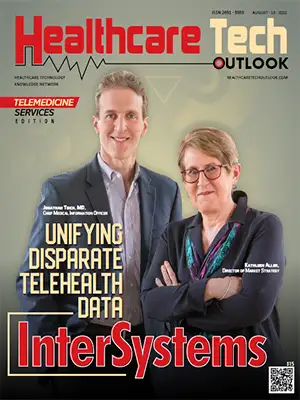
 Jonathan Teich, MD, Chief Medical Information Officer & Kathleen Aller, Director of Market Strategy, InterSystems
“InterSystems is not a telehealth provider. Rather, we empower telehealth, by delivering data management capabilities required for digital health workflows so that all stakeholders are viewing and building on the same information set,” says Kathleen Aller, Director of Market Strategy at InterSystems. By providing comprehensive data and analytics through its HealthShare Unified Care Record, InterSystems presents clear electronic health record data for physicians meeting a patient for the first time. Built on InterSystems IRIS for Health proprietary data platform, HealthShare connects with any EHR system, allowing practitioners a bird’s eye view of patient medical histories to reduce the time they spend on virtual treatment or consultation.

Working in synergy with all client data sources, InterSystems makes it easy to visualize medical data and for physicians to access customized dashboards, care plans, and care coordination templates, as well as being notified when new patient information becomes available.
A Foundation for Telehealth Solutions
InterSystems’ IRIS for Health cloud-first data platform was created specifically to support health information technology (HIT) and telehealth solution development. It embeds healthcare interoperability standards, including HL7 FHIR, as standard functionality. The highly-scalable data platform is so widely used in healthcare software development that there are more than one billion health records managed by systems built on it, including InterSystems own TrakCare EHR as well as HealthShare.
For clients building their digital solutions on top of InterSystems IRIS for Health, InterSystems offers educational programs on relevant technical know-how and developer training to help them create impressive digital and telehealth solutions. “Working in tandem with an extensive community of developers, users can share ideas or exchange code samples to understand best methods in getting started and creating their own proprietary solutions,” says Aller.
When designing its digital health solutions, InterSystems is always looking to steer clearer paths for providers and to bring clarity to patient medical histories, both by unifying data and then by empowering customers to create new insights.
For example, in the midst of the SARS CoV-2 spread, many customers used HealthShare to develop their own COVID-19 information dashboards. “We support several United States’ state health information exchanges, and many of them used our platform to send public health notifications or deliver key information of the spread and cases in their regions,” says Jonathan Teich, MD, Chief Medical Information Officer at InterSystems. He continues, “We have a solid health data model because of our expansive knowledge of the healthcare space. We organize and provide information that aligns with procedures a physician carries out in any given instance.”
Going the Extra Mile
Similarly, with InterSystems TrakCare EHR, patient data management modules are constructed around a single, unified record for each patient. The system, sold only outside the US, is designed as a global product that can be configured to represent the needs of each country of operation. As each region has its own health regulatory metrics and reporting requirements, InterSystems ensures that its EHR systems are consistent with local practice standards, terminologies, and treatment protocols.

We Support Several United States’ State Health Information Exchanges, and Many of Them Used Our Platform to Send Public Health Notifications or Deliver Key Information of the Spread and Cases in Their Regions

Going the Extra Mile
Widely recognized for its comprehensive customer support, InterSystems employs an enthusiastic and talented team of IT engineers that cater to specific client needs. And in the digital health space, those needs are diverse. Virtual care, or telehealth, ranges from simple text or messaging-based interactions with caregivers to vertically integrated, entirely online care organizations powered by digital apps and sometimes, AI enabled bots. What all these needs have in common is a focus on health data, and the need for interoperability. Every patient health record will contain information in a format that maintains common vocabularies and data models.
The InterSystems team provides its expertise to customers tackling five different kinds of telehealth challenges:
• Connecting and integrating devices and systems together. For example, “hospital in the home” is a remote care model that relies on continuous remote patient monitoring. It is only possible when monitors can be reliably connected to the “home base” information system. Similarly, tele-radiology and tele-ICU are both highly dependent on standards-based integration.
• Supplying comprehensive records for reference by providers treating patients with whom they have no previous relationship.
Having access to a patient’s problem list, allergies, medications, and recent care records leads to better, safer care.
• Delivering a seamless workflow to both patients and providers for telehealth visits, in the context of the EHR.
• Building new, cloud-native, FHIR-based digital health solutions for patients and caregivers to use for disease-specific as well as general health and wellness management.
• Bringing together and preparing large, disparate health data sets for use in machine learning to power AI-based telehealth.
InterSystems’ TrakCare EHR was customized to work seamlessly with various teleconferencing applications such as Zoom, Google Meet, MS Teams, and WeChat. One Chilean private healthcare network, which had been in the process of implementing TrakCare prior to the pandemic, made a rapid change to its deployment plan. Rather than going live within the walls of the hospital, the initial go live was for an entirely virtual clinic, powered by Google Meet. Only later did the traditional go live occur.
• Delivering a seamless workflow to both patients and providers for telehealth visits, in the context of the EHR.
• Building new, cloud-native, FHIR-based digital health solutions for patients and caregivers to use for disease-specific as well as general health and wellness management.
• Bringing together and preparing large, disparate health data sets for use in machine learning to power AI-based telehealth.
Whatever the customer need, the team provides hands-on assistance to build or configure their solutions.
Advanced Telehealth Data Applicability
During the initial wave of the COVID-19 pandemic, InterSystems was called on to support new types of data in all its products, for instance travel screening questionnaires, new testing indicators and new codes for diagnoses and procedures. At the same time, provider organizations around the world had to rapidly switch to virtual patient consultation workflows.
-
Intersystems is not a Telehealth Provider. Rather, We Empower Telehealth, By Delivering Data Management Capabilities Required For Digital Health Workflows So That All Stakeholders Are Viewing and Building on the Same Information Set
InterSystems’ TrakCare EHR was customized to work seamlessly with various teleconferencing applications such as Zoom, Google Meet, MS Teams, and WeChat. One Chilean private healthcare network, which had been in the process of implementing TrakCare prior to the pandemic, made a rapid change to its deployment plan. Rather than going live within the walls of the hospital, the initial go live was for an entirely virtual clinic, powered by Google Meet. Only later did the traditional go live occur.
From a caregiver’s perspective, these new options for communication and virtual visits allow for better engagement between all parties. Physicians can easily connect with patients via the telemedicine application of choice and also document any new medical conditions, just as they would during in person visits.
Approximately 30% of the world’s data is for healthcare, and digital health applications are being added to mobile marketplaces at the rate of over 200 apps per day. With this kind of growth, InterSystems closely monitors incoming data to identify new opportunities and create solutions that can derive the utmost value for its clients. InterSystems will continue to invest in the latest digital and telehealth trends to power next generation home patient monitoring and treatment systems and continue to deliver the highest capacity, speed, and health data-driven capabilities.
Company
InterSystems
Management
Jonathan Teich, MD, Chief Medical Information Officer & Kathleen Aller, Director of Market Strategy, InterSystems
Description
InterSystems is a technology services and consulting provider that empowers telehealth by delivering data management capabilities required for digital health workflows so that all stakeholders are viewing and building on the same information set.

InterSystems News
Ventana Research Awards InterSystems IRIS an “Exemplary” Rating and a Top Ranking in its 2023 Value Index for Data Platforms Report
InterSystems expands InterSystems IRIS data platform with vector search to support next-generation AI applications
InterSystems is adding vector search to the InterSystems IRIS data platform to enable efficient and accurate retrieval of relevant information from massive datasets when working with large language models.
rtificial intelligence has transformative potential for driving value and insights from data. It is to support this that InterSystems, a creative data technology provider dedicated to helping customers solve their most critical scalability, interoperability and speed problems, is pleased to announce the addition of vector search to the InterSystems IRIS data platform.
As businesses move towards a world where nearly every application will be AI-driven, developers building those applications will need the right tools for creating experiences from these applications. Vector search represents a fundamental evolution in the InterSystems IRIS data platform, offering unparalleled support for next-generation AI applications. By leveraging advanced vector-based search capabilities, InterSystems IRIS now empowers developers and enterprises to unlock new possibilities in AI-driven insights, decision-making and user experiences.
"At InterSystems, we are always looking for ways to bring next-generation data processing capabilities closer to our customers' data without having to transfer data to specialised systems," said Henry Adams, Country Manager at InterSystems South Africa.
By adding vector search to the InterSystems IRIS data platform, the company makes its data platform searchable through vector embeddings to enhance its functionality for tasks related to natural language processing, text and image analysis. When working with large language models, this functionality enables efficient and accurate retrieval of relevant information from massive datasets across the organisation.
Empowering developers for generative AI
This integration will make it easier for developers to create applications that use generative AI to complete complex tasks for a wide range of use cases and deliver up-to-date responses based on proprietary data processed by InterSystems. It also means they can do this with very curated data while being confident in keeping their internal proprietary intelligence secure.
This capability allows the InterSystems IRIS data platform to manage and query content and related dense vector embeddings, particularly as it enables retrieval-augmented generation (RAG) integration to develop generative AI-based applications. With the rapidly evolving toolsets available, seamless RAG integration allows agile adoption for new models and use cases.
"Vector search will fundamentally change how developers interact with InterSystems IRIS. We are excited to bring it to market," Adams said. "Our commitment to maintaining the highest standards of privacy, security and responsibility will guide a thoughtful and ethical approach to AI that creates trust while accelerating innovation, ensuring customer success and demonstrating a commitment to excellence."
rtificial intelligence has transformative potential for driving value and insights from data. It is to support this that InterSystems, a creative data technology provider dedicated to helping customers solve their most critical scalability, interoperability and speed problems, is pleased to announce the addition of vector search to the InterSystems IRIS data platform.
As businesses move towards a world where nearly every application will be AI-driven, developers building those applications will need the right tools for creating experiences from these applications. Vector search represents a fundamental evolution in the InterSystems IRIS data platform, offering unparalleled support for next-generation AI applications. By leveraging advanced vector-based search capabilities, InterSystems IRIS now empowers developers and enterprises to unlock new possibilities in AI-driven insights, decision-making and user experiences.
"At InterSystems, we are always looking for ways to bring next-generation data processing capabilities closer to our customers' data without having to transfer data to specialised systems," said Henry Adams, Country Manager at InterSystems South Africa.
By adding vector search to the InterSystems IRIS data platform, the company makes its data platform searchable through vector embeddings to enhance its functionality for tasks related to natural language processing, text and image analysis. When working with large language models, this functionality enables efficient and accurate retrieval of relevant information from massive datasets across the organisation.
Empowering developers for generative AI
This integration will make it easier for developers to create applications that use generative AI to complete complex tasks for a wide range of use cases and deliver up-to-date responses based on proprietary data processed by InterSystems. It also means they can do this with very curated data while being confident in keeping their internal proprietary intelligence secure.
This capability allows the InterSystems IRIS data platform to manage and query content and related dense vector embeddings, particularly as it enables retrieval-augmented generation (RAG) integration to develop generative AI-based applications. With the rapidly evolving toolsets available, seamless RAG integration allows agile adoption for new models and use cases.
"Vector search will fundamentally change how developers interact with InterSystems IRIS. We are excited to bring it to market," Adams said. "Our commitment to maintaining the highest standards of privacy, security and responsibility will guide a thoughtful and ethical approach to AI that creates trust while accelerating innovation, ensuring customer success and demonstrating a commitment to excellence."

The Ventana Research 2023 Value Index for Data Platforms provides an independent, holistic view of thirteen vendors’ ability to serve a combination of both operational and analytic workloads with either a single data platform product or multiple data platform products. In the report, InterSystems IRIS ranks third overall, and second in the Product Experience, Usability, and Adaptability categories.
Matt Aslett, VP & Research Director at Ventana Research said, “As a cloud-first data platform, InterSystems IRIS can reduce the need to implement and integrate multiple technologies, resulting in less code, fewer system resources, and less maintenance. I recommend that organizations that are migrating to the cloud and are looking for a platform to provide a consistent, accurate and real-time view of their enterprise data should evaluate InterSystems.”
InterSystems success reflects its ability to provide native analytic and operational capabilities in a single product. The next generation InterSystems IRIS data platform provides built-in high performance database management, interoperability, and analytics capabilities, and eliminates the need to copy data from an operational database to a separate analytic database.
The second-place ranking for the Adaptability category demonstrates InterSystems commitment to meeting customer requirements and high rates of customer satisfaction. Using InterSystems IRIS, developers are able to use their programming language of choice, while Embedded Python support enables Python developers to gain direct server-side access to all of the functionality in the platform, providing a familiar programming environment for the more than eight million Python developers worldwide.
InterSystems IRIS ability to meet the varying business needs of executives, management, workers and analysts, along with IT and others involved in data platforms contributed to achieving a ranking of second in the Usability category. It was also ranked second in Product Experience.
Joe Lichtenberg, Global Head of Product and Industry Marketing, InterSystems, said, “We are delighted that our InterSystems IRIS data platform has been recognized as third overall among the top thirteen data platform vendors by Ventana Research, as well as recognizing InterSystems as an ‘Exemplary’ vendor. In today’s landscape, data platforms are essential to support concurrent operational and analytical workloads to ensure organizations obtain the real-time data and insights they need to manage disruptions, identify new opportunities, and move their businesses forward. Coming out ahead of well-respected vendors such as Microsoft, Amazon, SAP, and Google in Ventana Research’s overall ranking is testimony to InterSystems deep commitment to our customers’ success, and our ability to deliver the functionality, performance, usability, and reliability our customers require.”