


THANK YOU FOR SUBSCRIBING
Weekly Brief
Be first to read the latest tech news, Industry Leader's Insights, and CIO interviews of medium and large enterprises exclusively from Healthcare Tech Outlook
A featured contribution from Leadership Perspectives: a curated forum reserved for leaders nominated by our subscribers and vetted by our Healthcare Tech Outlook Advisory Board.

Clinical/Lab Information Systems and Operations
7 Steps of Healthcare Innovation and Product Commercialization

Zoltan Nagymanyoki
Without innovation and agility, organizations become obsolete and cease to exist. Innovation in healthcare, however, is challenged by the complexity of care and regulations. Millions of discoveries are published every year, yet only a handful make it to mainstream medical practice. This is because any commercialized product, service, or solution must be suitable and solve a problem for ALL stakeholders in healthcare: 1) Patients, 2) Physicians or Providers, 3) Healthcare Organizations, and 4) Payors to get widely adopted. The “Blue Ocean Strategy” is very challenging in healthcare because, while patients and providers may see the new product as something beneficial, payors may see it as an additional burden. Payors need to see value in the product. It needs to improve health outcomes or reduce the cost of care, or ideally both, to reduce “conflict of interest” between stakeholders.
At great organizations, innovation starts with building an “Innovation Network” that generates a LOT of ideas. Those ideas then feed into the “Innovation/Commercialization” pipeline, which is a 7-step evaluation process. The steps are as follows:
The process starts with a wide-network of people aware of the innovation process. A clinical need may arise anywhere inside (or even outside) the organization, and should ideally find its way to the pipeline. Note: For this to happen, it’s essential that innovation and agility become part of the culture, and that everyone’s ideas are heard, communicated, and unbiased.
The idea should first undergo an “Initial Evaluation” asking three fundamental questions:
● Is a specific medical need addressed or value created?
● Is it technically feasible at scale?
● Does it fit the organization’s Business Strategy?
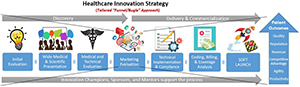 If all questions are answered positively, then the idea is presented to a Scientific and Medical Committee designed to represent the widest-spectrum of expertise within the organization. This is a great forum to ask further questions or add other factors for consideration. If an idea is deemed feasible by the wide-expert committee, then a specific “Task Force” will evaluate the clinical and analytical validity of the product/solution. This Medical and Scientific Review would include a literature review, competitive market analysis, and trials of the product or solution. The “Evaluation Summary” is reviewed at the highest-level of the organization. AProject Manager is appointed, if approved, to complete the commercialization process following regulatory, Project Management Body of Knowledge (PMBOK),and other relevant guidelines, processes, and tools (e.g., Agile, Waterfall, or Hybrid).
The Project Manager will help facilitate a comprehensive Marketing Evaluation, including working with others to identify Key Opinion Leaders (KOLs), establishing Focus Groups, and working with financial, marketing, technical, and other experts to develop a Cost-Benefit Comparison/Pricing Model and Marketing Strategy. Other key Marketing deliverables include: Value-Proposition Brochure emphasizing Clinical Utility | Test Performance and Methodology, Publication Abstract Compendium (a comprehensive document of all supporting publications and studies), various stakeholder training and education materials, a transparent, evidence-based Dossier, and any additional Marketing Assets that can be utilized in selling efforts.
"At great organizations, innovation starts with building an “Innovation Network” that generates a lot of ideas. Those ideas then feed into the “innovation and commercialization” pipeline"
Certain products also require U.S. Food & Drug Administration (FDA) and Institutional Review Board (IRB) approval. If so, specific steps must be followed to request and obtain IRB, FDA or relevant stakeholder approvals. Clinical and Technical Validations of the product/solution must take place, ideally using well-powered “Independent Samples” to eliminate bias and improve data quality/integrity.
IT infrastructure, Human Resources (HR), privacy, security, compliance, and other regulatory requirements must also be confirmed and met, including for external partners/vendors, and any Capital and HR expenditures timely-approved and procured. Supply Chains and the appropriate partners/vendors must be carefully evaluated and selected via Request for Proposal (RFP) process. Development approaches and timelines should also meet the requirements.
Detailed Coverage Analysis needs to be conducted related to Procedure and Diagnosis Coding, needed for billing, including a thorough review of Government and Private Payor Local and National Coverage Determinations (LCDs). 3rd Party Payors only consider products/solutions for reimbursement that are proven to achieve better health outcomes, improve quality, and lower costs, though costs should NOT be the deciding factor. Some innovative products/solutions may be able to utilize an existing Procedure Code, whereas others require American Medical Association (AMA) new Procedure Code approval (CPT, HCPCS, or PLA Code), each with different rules, timelines for approval, and coverage restrictions.
A Product Pricing Recommendation Crosswalk for the new Procedure Code also needs to be prepared and submitted to KOLs for review, then to payors to help determine to price. Note: Private Payors tend to discount the Centers for Medicare & Medicaid Services (CMS) price, thereby impacting provider reimbursement. So manufacturers and/or providers should set a price and NOT negotiate any lower. One should also take into consideration other Federal and State Regulations, including potential future reimbursement discounts. Clinical guidelines can change over time, presenting another risk. Other important considerations include where the new product/solution fits into providers’ current treatment algorithm(s), and the acceptance of the new product/solution as a “Standard of Care.” Considering diagnostic reports, the look, feel, and resulting data are important along with providers’ and patients’ ability to interpret.
Before launching a new product or enhancement to an existing product, Integrated Testing is required and coordinated stakeholder training(s) recommended, where appropriate. Warranty Monitoringpost-launch for a specific or reasonable time is also recommended to ensure the product/solution is performing to expectations before a strategic hand-off to operations teams and any continued Sales and Marketing efforts. Ongoing quality review is also very important, as impacted stakeholders should be involved and provide feedback throughout each stage of the implementation process, including beyond the Minimum Viable Product (MVP). Marketing materials should also be tailored to each stakeholder.
Data collection and reporting (e.g., Dashboard or other) are highly-recommended to track patients and providers using the new product/service. Data collection, at a minimum, must include operational effectiveness, product adoption rate, and patient outcomes. Periodic (3-6 months) post-launch re-evaluation of products and results should occur.
The articles from these contributors are based on their personal expertise and viewpoints, and do not necessarily reflect the opinions of their employers or affiliated organizations.
