THANK YOU FOR SUBSCRIBING
Weekly Brief
Be first to read the latest tech news, Industry Leader's Insights, and CIO interviews of medium and large enterprises exclusively from Healthcare Tech Outlook


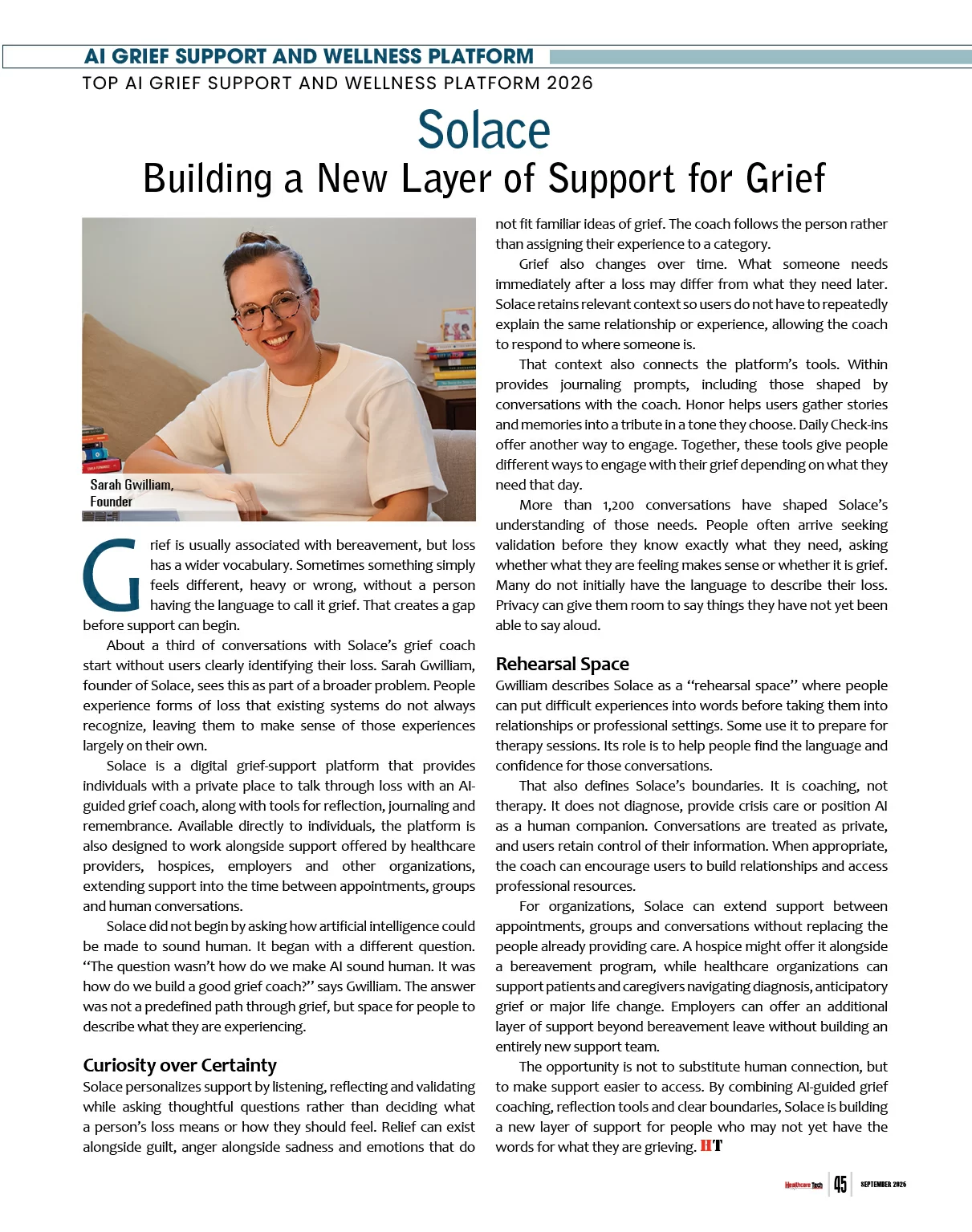
 Sarah Gwilliam, Founder, Solace
About a third of conversations with Solace’s grief coach start without users clearly identifying their loss. Sarah Gwilliam, founder of Solace, sees this as part of a broader problem. People experience forms of loss that existing systems do not always recognize, leaving them to make sense of those experiences largely on their own.
Solace is a digital grief-support platform that provides individuals with a private place to talk through loss with an AI-guided grief coach, along with tools for reflection, journaling and remembrance. Available directly to individuals, the platform is also designed to work alongside support offered by healthcare providers, hospices, employers and other organizations, extending support into the time between appointments, groups and human conversations.
Solace did not begin by asking how artificial intelligence could be made to sound human. It began with a different question. “The question wasn’t how do we make AI sound human. It was how do we build a good grief coach?” says Gwilliam. The answer was not a predefined path through grief, but space for people to describe what they are experiencing.
Curiosity over Certainty
Solace personalizes support by listening, reflecting and validating while asking thoughtful questions rather than deciding what a person’s loss means or how they should feel. Relief can exist alongside guilt, anger alongside sadness and emotions that do not fit familiar ideas of grief. The coach follows the person rather than assigning their experience to a category.
Grief also changes over time. What someone needs immediately after a loss may differ from what they need later. Solace retains relevant context so users do not have to repeatedly explain the same relationship or experience, allowing the coach to respond to where someone is.
That context also connects the platform’s tools. Within provides journaling prompts, including those shaped by conversations with the coach. Honor helps users gather stories and memories into a tribute in a tone they choose. Daily Check-ins offer another way to engage. Together, these tools give people different ways to engage with their grief depending on what they need that day.
More than 1,200 conversations have shaped Solace’s understanding of those needs. People often arrive seeking validation before they know exactly what they need, asking whether what they are feeling makes sense or whether it is grief. Many do not initially have the language to describe their loss. Privacy can give them room to say things they have not yet been able to say aloud.
-
Solace is really designed to strengthen human connection. That is my hope. It’s not to compete with it.
More than 1,200 conversations have shaped Solace’s understanding of those needs. People often arrive seeking validation before they know exactly what they need, asking whether what they are feeling makes sense or whether it is grief. Many do not initially have the language to describe their loss. Privacy can give them room to say things they have not yet been able to say aloud.
Rehearsal Space
Gwilliam describes Solace as a “rehearsal space” where people can put difficult experiences into words before taking them into relationships or professional settings. Some use it to prepare for therapy sessions. Its role is to help people find the language and confidence for those conversations.
That also defines Solace’s boundaries. It is coaching, not therapy. It does not diagnose, provide crisis care or position AI as a human companion. Conversations are treated as private, and users retain control of their information. When appropriate, the coach can encourage users to build relationships and access professional resources.
For organizations, Solace can extend support between appointments, groups and conversations without replacing the people already providing care. A hospice might offer it alongside a bereavement program, while healthcare organizations can support patients and caregivers navigating diagnosis, anticipatory grief or major life change. Employers can offer an additional layer of support beyond bereavement leave without building an entirely new support team.
The opportunity is not to substitute human connection, but to make support easier to access. By combining AI-guided grief coaching, reflection tools and clear boundaries, Solace is building a new layer of support for people who may not yet have the words for what they are grieving.
Extending Grief Support without Replacing Human Care
Grief support often reaches people at the wrong depth or the wrong moment. Bereavement benefits may provide a short period of leave, while traditional resources can fade after the initial period of loss. Static material cannot adapt as a person’s experience changes. For executives evaluating AI grief support, the central question is not whether technology can produce comforting language. It is whether the service can remain useful over time without blurring its role. A useful service must support reflection without claiming authority over what grief should look like.
Loss rarely arrives in language neat enough for a preset digital journey. People may be processing anticipatory loss or caregiving strain. Others may be dealing with divorce, retirement, identity change or pet loss. A platform built around rigid labels can miss users who cannot yet name what they are experiencing. More useful support leaves room for uncertainty and follows the person’s own language. It should not assume that grief must move through a fixed emotional sequence.
Time exposes another weakness in conventional support. Grief can change long after the first period of attention has passed, yet disconnected interactions force users to retell the same relationship or loss. Digital support should retain relevant context without making continued engagement an obligation. Context retention also reduces friction at reentry, when a user returns later with a different concern. Conversation will not fit every day. Writing or a short check-in may work better on another. Shared context across those interactions matters more than offering a large menu of features.
“Solace’s design favors continued access without encouraging dependency, while directing users toward human relationships or professional support when appropriate.”
Emotional safety is harder to judge from interface polish. An AI service should make its nonhuman status clear and maintain firm limits around therapy or crisis care. Engagement should never become the goal when a vulnerable user may need encouragement toward a friend, clinician, support group or other human resource. Privacy controls deserve similar scrutiny in practice because personal disclosure is central to the experience, not incidental data created around it. Users also need clear control over the information attached to those exchanges.
Institutional use raises the same boundary question at a larger scale. Hospices and employers may want to extend support without building a new internal program or presenting AI as clinical care. Healthcare providers face a related issue when patients or caregivers are processing loss around diagnosis or changing health. The better fit is a service that can sit beside existing human resources and give people a private starting point. It should also direct them outward when human judgment or presence is more appropriate. Access expands, but the institution’s core duty of care remains clear.
Solace merits consideration as a premier choice for organizations that want an AI grief support layer alongside existing human services. Its grief coach follows the user’s language rather than assigning a preset journey and retains relevant context across return visits. It also maintains explicit boundaries around therapy or crisis care. Its Honor tribute tool, Within journal and optional daily check-ins give users different ways to engage while sharing context across the experience. Its design favors continued access without encouraging dependency, while directing users toward human relationships or professional support when appropriate. For buyers prioritizing continuity without dependency and support that complements human care, Solace offers a closely aligned model.
...Read more
AI Grief Support and Wellness Platforms Info
Q1
What Are AI Grief Support and Wellness Platforms Designed to Provide?
Through guided reflection and conversational support, AI Grief Support and Wellness Platforms offer a private, accessible environment for individuals to process various types of loss. These platforms can assist users in describing feelings, identifying what they are going through, and finding vocabulary for challenging talks rather than thinking that mourning follows a single course. Instead than taking the place of therapy, crisis care, or interpersonal interactions, their role is supporting.
Q2
How Does Solace Apply AI Grief Support and Wellness Platforms to Different Experiences of Loss?
Solace approaches AI Grief Support and Wellness Platforms through an AI-guided grief coach that listens, reflects and asks questions without assigning a fixed meaning to a user's experience. Its support extends beyond bereavement to experiences including caregiving, diagnosis, divorce, job loss, retirement, identity change and pet loss. This broader approach recognizes that loss can be difficult to identify before someone has words for it.
Q3
What Features Matter When Evaluating Grief Support and Wellness Technology?
Grief support and wellness technology should be so much more than a conversation interface. The usefulness of the experience may change over time based on context, privacy, reflection tools and clear boundaries. Solace maintains context for the conversations, allowing users to avoid re-stating the same relationship or experience. It's also integrated with journaling prompts and remembrance tributes and daily check-ins, offering multiple points of engagement to users. The key features of an AI Grief Support and Wellness Platform can contribute to various stages of a user's journey.
Q4
How Can AI-Powered Grief Support Complement Human Care?
Grief support using AI can offer support between human-provided appointments, groups, and between human conversations, without losing focus of professional care. These tools may be used to help users plan for therapy, or to self-explain or consider the experience prior to having a conversation with family members or care teams. The best fit is complementary, where AI-powered support is used to create access to reflection without the guise of therapy, or taking the place of professional or personal connection.
Q5
What Boundaries Should Users Expect From Digital Grief Support Tools?
The boundaries of digital grief support tools should be made apparent. Solace is a coach rather than a therapist; it does not provide crisis treatment or diagnosis. Confidential conversations take place, individuals retain ownership over their information, and when necessary, the coach can promote better interpersonal connections or professional resources. These boundaries might be thought of as separating clinical therapy or an artificial human being from supportive technology.
Q6
How Is Solace Building Practical Value Through AI Grief Support and Wellness Platforms?
AI Grief Support and Wellness Platforms serve as a ‘rehearsal space' for challenging moments at Solace. Over 1200 conversations have helped shape its understanding of user needs and its tools enable reflection, remembrance and daily engagement. The platform can be used directly by individuals and also in combination with health care providers, hospices and employers, providing care and support in addition to the people already providing care.

Company
Solace
Management
Sarah Gwilliam, Founder, Solace
Description
Solace is an AI-guided grief-support platform designed to provide accessible and contextual support for people experiencing different forms of loss. Its approach extends beyond bereavement to include experiences such as caregiving, diagnosis, divorce, job loss, retirement, identity change and pet loss. The platform combines an AI-guided grief coach with tools for journaling, tributes and daily check-ins, allowing users to engage with grief in different ways while maintaining shared context across the experience.