


THANK YOU FOR SUBSCRIBING
Weekly Brief
Be first to read the latest tech news, Industry Leader's Insights, and CIO interviews of medium and large enterprises exclusively from Healthcare Tech Outlook


Medical imaging is witnessing unprecedented innovation as the healthcare industry embraces precision and value-based medicine. Especially with advances in MRI, radiologists and neurologists are now able to acquire and process brain images in less time and in greater detail. Some of the latest innovations are helping healthcare providers accurately diagnose and treat brain diseases such as Alzheimer’s and Parkinson’s more quickly while improving patient outcomes and health system financial performance through greater access to advanced imaging.
For patients and their families, STAGE helps expand access to enhanced imaging and increases diagnostic speed and accuracy. It improves patient experiences by reducing the time required to lay still in the confined circular space typical of most MRI machines. The increasing consumerization of ealthcare and higher patient satisfaction ultimately boosts hospital ratings and improves its long-term financial integrity.
At the leading edge of imaging innovation is the Strategically Acquired Gradient Echo (STAGE) platform developed by SpinTech MRI, a fast-rising medical technology company.
SpinTech MRI’s STAGE technology facilitates faster acquisition and processing of multi-contrast MRI data, streamlining radiology workloads, increasing patient throughput and reducing healthcare costs. STAGE software integrates with 3T and 1.5T MRI machines and radiology workflows used at many hospitals and imaging centers. It enables physicians to easily access, analyze and visualize large MRI datasets and generate quantitative 3D maps for faster detection of brain disease biomarkers. It also helps health systems improve the ROI of expensive MRI machines even as imaging reimbursements decrease.
“Our technology reduces brain imaging acquisition times by 40 percent and enables physicians to get comprehensive, quantitative multi-contrast 3D data, and images in four to six minutes,” says Karen Holzberger, president and CEO of SpinTech MRI.
STAGE is clearly a step up from the traditional qualitative visual interpretation of MRI images or compressed sensing and image reconstruction techniques, which shorten scan times by acquiring less data and fill any gaps with AI-based interpolation. STAGE acquires all relevant qualitative and quantitative data without trade-offs in imaging time, cost, complexity, or the availability of data that neurologists rely on for diagnosis, surgical interventions, or patient monitoring.

Our technology reduces brain imaging acquisition times by 40 percent and enables physicians to get comprehensive, quantitative, multi-contrast 3D data and images in four to six minutes

For patients and their families, STAGE helps expand access to enhanced imaging and increases diagnostic speed and accuracy. It improves patient experiences by reducing the time required to lay still in the confined circular space typical of most MRI machines. The increasing consumerization of ealthcare and higher patient satisfaction ultimately boosts hospital ratings and improves its long-term financial integrity.
The Roots of MRI Excellence
The development of STAGE technology and growth of SpinTech MRI can be attributed to Dr. Mark Haacke, Ph.D. A former president of the International Society of Magnetic Resonance in Medicine and the International Society of Neurovascular Diseases, Dr. Haacke has published over 300 papers, been cited more than 300,000 times by other MRI researchers, and awarded over 18 technology patents.
With the aim of alleviating radiologist workloads, empowering neurologists with critical diagnostic information, and improving patient outcomes, Dr. Haacke has transformed his physics and MR imaging research into practical clinical applications.
That work includes important MR angiography (MRA) and susceptibility weighted imaging (SWI) techniques that continue to revolutionize MRI diagnostics. The current culmination of his ongoing scientific research and practical technology expertise is STAGE, which received 510(k) clearance from the FDA in 2021.
Under the Hood of STAGE Technology
SpinTech MRI’s STAGE software is easily installed and integrated with existing scanner, PACS (picture archiving and communication system), and radiology reporting workflows. Traditional MRI protocols require neurologists and radiologists to define and implement machine-specific settings with exacting precision for each scan. But STAGE enables them to simply decide which brain features they want to image, acquire multi-contrast data in a single scan, and then process and analyze images and data as needed. STAGE software produces standardized datasets regardless of scanner make or model. Scans using STAGE typically take five minutes compared to as much as 15-20 minutes using traditional techniques.
Just as a digital camera can record device, exposure and other metadata with each image, STAGE records information about the MRI machine and settings used along with image and biomarker data in a standardized format regardless of scanner make or model. That ensures accuracy, output consistency between scanners, and reproducibility needed for monitoring disease progression and treatment effectiveness. The data can also be used for research or for training AI models.
“Our approach goes beyond presumptive reconstructions and delves into comprehensive and actual 3D data of disease biomarkers, enabling radiologists and neurologists to achieve accurate representation of brain conditions,” says Ward Detwiler, co-founder and chief commercial officer of SpinTech MRI.
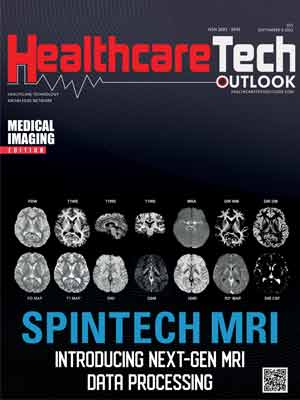
With STAGE, radiologists can view up to 17 imaging outputs, including the measurement of changes in blood, iron, oxygen, and water levels in different parts of the brain that indicate disease and disease sub-types.
Working within existing workflows without requiring added time or steps, STAGE enables radiologists to provide detailed quantitative and qualitative data to neurologists and neurosurgeons to inform diagnostic and treatment decisions based on specific patient needs.
Expanding Clinical Applications for STAGE
SpinTech MRI is developing additional clinical applications of the STAGE platform. One includes the use of STAGE data and images for improved guidance of radiation therapy for brain tumors. Another is for the automatic detection of the number, size, and location of brain microbleeds, which can be important predictors of post-surgical patient recovery and cognitive outcomes.
Researchers at Yale University School of Medicine are evaluating how implementing STAGE in a busy neuroradiology practice can reduce acquisition times, improve throughput, and enhance diagnosis of Parkinson’s disease, traumatic brain injury (TBI), and other disorders. They are also studying the advantages of using STAGE versus AI based image reconstruction to improve workflow efficiency and reduce scan times. Those benefits are especially relevant for pediatric neuroimaging, where faster scans reduce the need for and risks associated with anesthesia, and for rapid screening in patients with suspected stroke.
-
Our approach goes beyond presumptive reconstructions and delves into comprehensive and actual 3D data of disease biomarkers, enabling radiologists and neurologists to achieve accurate representation of brain conditions
SpinTech MRI is developing additional clinical applications of the STAGE platform. One includes the use of STAGE data and images for improved guidance of radiation therapy for brain tumors. Another is for the automatic detection of the number, size, and location of brain microbleeds, which can be important predictors of post-surgical patient recovery and cognitive outcomes.
Guiding Healthcare Researchers and Providers to the Future of MRI
With more than 20 patents and over 100 research papers on STAGE technology, SpinTech MRI is carving a unique spot in the medical innovation space. SpinTech MRI scientists are actively collaborating with leading MRI researchers worldwide and expanding the company’s seminal role in connecting academic studies to real-life clinical needs and practical applications for Parkinson’s disease, TBI, dementia, cerebral microbleeds, and other neurological disorders.
SpinTech MRI is focusing on commercial deployments of STAGE in the U.S. and Canada, before expanding to other countries. Simultaneously, the company is increasing clinical applications of STAGE for neck, spine, knee, and ankle disorders. While the company’s technology and solutions are based on sophisticated and advanced physics and medical research, its practical approach is firmly grounded in empowering physicians to provide superior care and in improving people’s lives.

Company
SpinTech MRI
Management
Karen Holzberger, President and CEO, Ward Detwiler, Co-Founder and Chief Commercial Officer, SpinTech MRI
Description
SpinTech MRI is a fast-rising medical technology company offering a unique MR data acquisition and processing technology that guarantees unparalleled acquisition speed and data quality without tradeoffs.

SpinTech MRI News
SpinTech MRI and Yale New Haven Hospital to Examine Impact of STAGE on MRI Brain Exam Times, Backlogs, Workflows and Outcomes in Routine Clinical Use
SpinTech MRI and Canon Medical Systems USA Breaking New Ground with the Development of a Fully Quantitative Fast MRI Solution for Clinical Use
Physics-based STAGE™ quantitative output and ground truth data used with Canon AiCE (Advanced intelligent Clear-IQ Engine) deep learning reconstruction could significantly expand MRI access for neuroimaging
BINGHAM FARMS - SpinTech MRI, creators of the STAGE™ (STrategically Acquired Gradient Echo) quantitative magnetic resonance imaging (MRI) software platform, and Canon Medical Systems USA, Inc., a commercial subsidiary of Canon Medical Systems Corporation, a global leader in innovative diagnostic imaging technology, today announced the development of a fully quantitative fast MRI solution for clinical use, combining MR physics and AI-based deep learning reconstruction to generate 3D brain images with greater clarity and contrast. A fully quantitative MRI solution for clinical use provides multiparametric maps, allowing for quantitative measures of tissue properties, including parameters like T1, T2, and Proton density.
The collaboration evaluated the performance of Canon Advanced intelligent Clear-IQ Engine (AiCE) Deep Learning Reconstruction (DLR) technology combined with STAGE for accelerated acquisition of ground-truth data and generation of high-quality 3D brain images with increased signal-to-noise ratio (SNR) using a 1.5T Canon Medical Systems scanner.
Results demonstrated that the combined solution had significant potential to expand MRI availability for clinical neuroimaging with significantly shorter exams while giving clinical neuroradiologists high-quality images and quantitative outputs for confident and efficient interpretation. It could help health systems meet surging demand amid staff shortages, radiologist burnout and other challenges. Shorter exams also can increase patient comfort and reduce sedation rates, imaging backlogs and health systems financial pressures.
"Our results demonstrated the feasibility of using the combined AiCE DLR-STAGE method for accelerated exams on a 1.5T scanner with 3T- enhanced resolution for gray matter/white matter contrast and 3D quantitative outputs in clinical practice," said Mo Kadbi, PhD, Medical Affairs Leader – MRI at Canon Medical Systems USA. "It also has the potential to expand scanner access with much shorter exams and assure radiologists that they have the information they need for confident and efficient interpretation."
Acquisition of two 3D multi-echo gradient echo sequences used parallel imaging and 3D k-space under-sampling, then reconstruction with conventional techniques and AiCE DLR. Data were then post-processed with STAGE to generate five quantitative maps and seven clinical contrasts. SNR and corresponding image clarity and contrast using the combined AiCE DLR-STAGE approach were better than conventional reconstruction. Moreover, the combined solution enabled significantly faster exams, greater efficiency gains and better image clarity and detail than either AiCE DLR or STAGE alone.
Conventional "fast MRI" techniques that use subsampled data acquired during shorter exams and AI-generated synthetic data to improve image quality show promise in some clinical areas. However, concerns about performance and accuracy in clinical neuroimaging limit their adoption.
"AiCE DLR technology overcomes the drawbacks of conventional reconstruction by accelerating acquisition and removing image noise more effectively to generate sharp, clear and distinct images," said Karen Holzberger. CEO of SpinTech MRI. "STAGE multiplies those benefits with additional time-savings to increase scanner availability and reduce backlogs, and high-quality 3D images and workflow-integrated quantitative outputs for diagnostic confidence."
STAGE post-processing software is designed to enhance MRI data acquisition and potentially reduce brain exam duration. It generates images with improved clarity and grey matter/white matter contrast and increased signal-to-noise ratio. The software quickly integrates with existing PACS and 1.5T and 3T scanners and requires no changes to reading and reporting workflows. STAGE also provides practical and intuitive access to quantitative outputs such as QSM and T1 maps for better detection of neurological disease biomarkers.
"This is an excellent example of how health system administrators, radiologists and technology vendors can collaborate to create effective solutions for challenges we face today," said Dr. James W. Backstrom, MD, a neuroradiologist, STAGE user and CMO at Armstrong County Memorial Hospital in Pennsylvania, who initiated the development project. "I've been impressed with SpinTech MRI's capabilities and Canon's strength in advancing imaging technology and outcomes, both of which aligned with our own long-standing commitment to innovation. We believe the combined STAGE-AiCE solution can quickly produce meaningful improvements in operational efficiency and patient outcomes at health systems of any size."
BINGHAM FARMS - SpinTech MRI, creators of the STAGE™ (STrategically Acquired Gradient Echo) quantitative magnetic resonance imaging (MRI) software platform, and Canon Medical Systems USA, Inc., a commercial subsidiary of Canon Medical Systems Corporation, a global leader in innovative diagnostic imaging technology, today announced the development of a fully quantitative fast MRI solution for clinical use, combining MR physics and AI-based deep learning reconstruction to generate 3D brain images with greater clarity and contrast. A fully quantitative MRI solution for clinical use provides multiparametric maps, allowing for quantitative measures of tissue properties, including parameters like T1, T2, and Proton density.
The collaboration evaluated the performance of Canon Advanced intelligent Clear-IQ Engine (AiCE) Deep Learning Reconstruction (DLR) technology combined with STAGE for accelerated acquisition of ground-truth data and generation of high-quality 3D brain images with increased signal-to-noise ratio (SNR) using a 1.5T Canon Medical Systems scanner.
Results demonstrated that the combined solution had significant potential to expand MRI availability for clinical neuroimaging with significantly shorter exams while giving clinical neuroradiologists high-quality images and quantitative outputs for confident and efficient interpretation. It could help health systems meet surging demand amid staff shortages, radiologist burnout and other challenges. Shorter exams also can increase patient comfort and reduce sedation rates, imaging backlogs and health systems financial pressures.
"Our results demonstrated the feasibility of using the combined AiCE DLR-STAGE method for accelerated exams on a 1.5T scanner with 3T- enhanced resolution for gray matter/white matter contrast and 3D quantitative outputs in clinical practice," said Mo Kadbi, PhD, Medical Affairs Leader – MRI at Canon Medical Systems USA. "It also has the potential to expand scanner access with much shorter exams and assure radiologists that they have the information they need for confident and efficient interpretation."
Acquisition of two 3D multi-echo gradient echo sequences used parallel imaging and 3D k-space under-sampling, then reconstruction with conventional techniques and AiCE DLR. Data were then post-processed with STAGE to generate five quantitative maps and seven clinical contrasts. SNR and corresponding image clarity and contrast using the combined AiCE DLR-STAGE approach were better than conventional reconstruction. Moreover, the combined solution enabled significantly faster exams, greater efficiency gains and better image clarity and detail than either AiCE DLR or STAGE alone.
Conventional "fast MRI" techniques that use subsampled data acquired during shorter exams and AI-generated synthetic data to improve image quality show promise in some clinical areas. However, concerns about performance and accuracy in clinical neuroimaging limit their adoption.
"AiCE DLR technology overcomes the drawbacks of conventional reconstruction by accelerating acquisition and removing image noise more effectively to generate sharp, clear and distinct images," said Karen Holzberger. CEO of SpinTech MRI. "STAGE multiplies those benefits with additional time-savings to increase scanner availability and reduce backlogs, and high-quality 3D images and workflow-integrated quantitative outputs for diagnostic confidence."
STAGE post-processing software is designed to enhance MRI data acquisition and potentially reduce brain exam duration. It generates images with improved clarity and grey matter/white matter contrast and increased signal-to-noise ratio. The software quickly integrates with existing PACS and 1.5T and 3T scanners and requires no changes to reading and reporting workflows. STAGE also provides practical and intuitive access to quantitative outputs such as QSM and T1 maps for better detection of neurological disease biomarkers.
"This is an excellent example of how health system administrators, radiologists and technology vendors can collaborate to create effective solutions for challenges we face today," said Dr. James W. Backstrom, MD, a neuroradiologist, STAGE user and CMO at Armstrong County Memorial Hospital in Pennsylvania, who initiated the development project. "I've been impressed with SpinTech MRI's capabilities and Canon's strength in advancing imaging technology and outcomes, both of which aligned with our own long-standing commitment to innovation. We believe the combined STAGE-AiCE solution can quickly produce meaningful improvements in operational efficiency and patient outcomes at health systems of any size."

BINGHAM FARMS - SpinTech MRI, announced that Yale New Haven Hospital and YNHH Center for Health Care Innovation is conducting an in-depth analysis of the operational and clinical impacts of using STAGE for routine neuroimaging exams.
Conducted in collaboration with SpinTech MRI, the analysis includes a multi-institutional review of patient cases to compare existing MRI processes with those using STAGE for Parkinson's, Alzheimer's and dementia, Multiple Sclerosis, stroke, and other neurological conditions. It will examine the impact of STAGE adoption on efficiency, exam duration, image quality, radiology reading and reporting workflows, scanner throughput, imaging backlogs, sedation rates, patient experiences and return on investment.
STAGE post-processing software uses advanced MRI physics to accelerate brain exams by 30% while improving image clarity and grey matter/white matter contrast by reducing image noise and increasing signal-to-noise ratio. The software quickly integrates with existing PACS and 1.5T and 3T scanners and requires no changes to reading and reporting workflows. STAGE also provides practical and intuitive access to quantitative outputs such as QSM and T1 maps for better detection of neurological disease biomarkers.
"MRI post-processing has shown a potential to improve MRI efficiency, reading and reporting, scanner throughput and patient experiences at scale," said Dr. Melissa A. Davis, MD, MBA, Vice Chair for Imaging Informatics, Radiology & Biomedical Imaging at Yale New Haven Hospital (YNHH) and Associate Professor of Radiology and Biomedical Imaging at the Yale School of Medicine. "The goal of our analysis with STAGE is to calculate the impact of those potential benefits through a review of cases and provide neuroradiologists with objective metrics for confident adoption of these types of tools in routine clinical practice."
Health systems are seeking to improve MRI efficiency, utilization, image quality and patient comfort in response to surging demand. Testing at a busy U.S. health system in 2022 showed that multi-contrast scans using STAGE averaged 30% faster than conventional protocols. The time savings created 3 to 4 new scanning slots per scanner per day.
"STAGE users report that faster acquisition, improved image clarity and contrast, and straightforward usability of quantitative maps in clinical practice are immediately evident," said SpinTech MRI President and CEO Karen Holzberger. "But administrators and radiologists already managing heavy demand are understandably cautious about adding tools to existing workflows. Our collaboration with one of the world's most highly regarded neuroradiology practices is aimed at providing an objective assessment of the benefits of STAGE in everyday clinical neuroimaging."