


THANK YOU FOR SUBSCRIBING
Weekly Brief
Be first to read the latest tech news, Industry Leader's Insights, and CIO interviews of medium and large enterprises exclusively from Healthcare Tech Outlook


 Dr. Alexander A. Oraevsky, CEO and CTO
“Our technology allows doctors to see through the body optically, as they would with their own eyes having a magnifying glass enabled by conversion of absorbed light into ultrasound,” says Dr. Alexander A. Oraevsky, CEO and CTO.
Optoacoustic imaging technology eliminates the risks of exposing patients to ionizing radiation and strong magnetic fields associated with traditional imaging of X-ray CT and MRI, the present methods that also often require injection of toxic contrast agents to produce the contrast needed for detailed visualization of soft tissues.
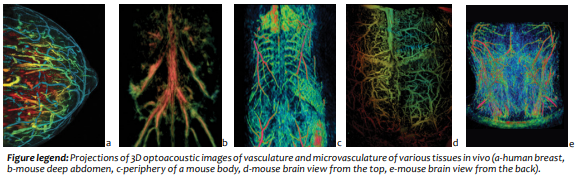 TomoWave’s proprietary systems deliver comprehensive imaging information that overlays molecular distribution onto structural anatomical maps. This information can reveal tissue functions and abnormalities within tissues. Due to the strong optical absorption of near-infrared light in hemoglobin and oxyhemoglobin of red blood cells, doctors and researchers can clearly visualize vasculature and microvasculature, assess its functional status, measure microvascular density and identify critical biomarkers like blood oxygen saturation in patients showing symptoms of breast cancer or who suffer from diabetes. This enables precise diagnostics, guided surgeries, and monitoring of minimally invasive therapeutic interventions. A video-rate imaging feature of TomoWave systems allows doctors to view continuous video-like sequences, while three-dimensional tomography provides quantitatively accurate volumetric images.
Decoding the Vision Behind the Innovation
Light scatters randomly when interacting with tissues, resulting in blurry, low-resolution images that prevent doctors from distinguishing the finer details within the body’s internal structures. This observation fueled the determination of Dr. Oraevsky to find a solution. Drawing inspiration from Professor Britton Chance—a renowned biochemist, biophysicist, scholar, and inventor whose work helped develop spectroscopy and imaging methods to diagnose medical problems, Alexander explored how to evaluate the molecular content of tissues and tissue functions simultaneously achieving deep tissue visualization. However, due to strong scattering of light in tissues the resolution and contrast of optical images were low.
 While working on a laser microsurgery project to remove tissues using short pulses to minimize thermal damage to neighboring tissues, Dr. Oraevsky observed that a sound was generated when even low optical energy pulses interacted with tissue. The sound propagated as spherical waves, giving him the idea to employ a triangulation principle known from the sonar (radar) technology where acoustic waves could pinpoint to sources of acoustic signals deep within tissues. He also formulated the principle of temporal pressure confinement in the voxels to be resolved to produce high-resolution images with remarkable contrast using the conversion of short optical pulses absorbed by tissue molecules into high-frequency sound waves (ultrasound).
The results of his experiments laid the foundation for the current TomoWave systems. These systems use special ultra-wide-band piezoelectric transducers to detect ultrasound waves and transform them into electronic signals, which are then reconstructed into detailed tomographic images of deep tissues. Each point in an image correlates with the concentration of specific molecules that absorb specific color of light determined by the laser wavelength selected for the imaging. Molecular and functional information is displayed in TomoWave images on the background of anatomical tissue structures visualized by high-end ultrasound. A unique feature of TomoWave optoacoustic tomography systems is the capability to visualize volumetric information, not only tissue boundaries. This previously unavailable feature is enabled by ultra-wide-band ultrasound transducers sensitive from low frequencies (for high contrast of larger structures) to high frequencies (for high spatial resolution).
Unlocking New Possibilities in Quantitative Imaging
TomoWave also has a patent on how to convert optoacoustic images into volumetric images of temperature, which paves the way for precisely controlled minimally invasive thermal therapy of cancerous tumors.
Optoacoustic imaging technology holds limitless potential across diagnostic and therapeutic applications. Capability of detecting early aggressive cancer represent a significant contribution of optoacoustic ultrasonic tomography to a global health problem. A major use-case is in screening and diagnostics of breast cancer in the dense and heterogeneous breast of younger women.
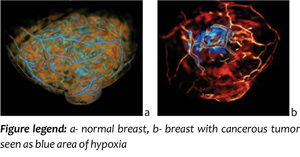
While ultrasound can detect the shadow of a tumor, in 70 percent of cases it fails to distinguish whether the tumor is benign or cancerous. The shape of the outgrowth alone does not offer enough diagnostic specificity for doctors. This uncertainty can lead to unnecessary biopsy or surgery in the case of a benign tumor. Furthermore, angiogenesis (formation of new microvasculature) during tissue healing after surgery may trigger aggressive growth of dormant tumors. Conversely, tumors that sometimes appear benign on ultrasound can turn out to be an early-stage yet highly aggressive cancer. Optoacoustic imaging technology’s ability to measure blood oxygen saturation levels and the presence or absence of microvasculature helps to rule out any uncertainties and arrive at an accurate diagnosis. TomoWave clinically validated its breast imaging system in a pilot study sponsored by the National Cancer Institute in collaboration with Prof. Wei Yang at the University of Texas MD Anderson Cancer Center. Prof. Mohammad Eghtedari, presently at the Moores Cancer Center at the University of California San Diego and Prof. Mark Anastasio, presently at the University of Illinois at Urbana Champaign, played critically important roles in the development and clinical testing of the TomoWave breast imaging system. “I truly appreciate expert advice of Prof. Eghtedari, MD in Radiology and PhD in optoacoustic imaging, and our long-standing collaboration with Prof. Anastasio and his group, world leading experts in medical tomography and specifically in optoacoustic and ultrasound imaging. Their participation in the development of TomoWave systems is invaluable”, says Alexander Oraevsky.

Our technology allows doctors to see through the body optically, as they would with their own eyes having a magnifying glass enabled by conversion of absorbed light into ultrasound

TomoWave also has a patent on how to convert optoacoustic images into volumetric images of temperature, which paves the way for precisely controlled minimally invasive thermal therapy of cancerous tumors.
Optoacoustic imaging also shows great promise for patients suffering from diabetes. Every 15 seconds, a diabetic patient loses a foot or hand to tissue death caused by poor circulation and lack of blood oxygenation. Reduced blood flow can cause numbness, which patients often overlook until the tissue is irreversibly damaged. Microvascular damage in these body parts also indicates damage in other vital organs, like the heart and brain. TomoWave systems adeptly detect microvascular damage and help patients take preventive measures.
The Road to Global Adoption
By making optoacoustic-ultrasonic imaging technology available for clinical research in humans and preclinical research in animal models, TomoWave is helping doctors and researchers become familiar with the product’s applications. Twenty-four systems are already in use. The company is focused on securing regulatory approvals from key bodies like the US Food and Drug Administration, China’s National Medical Products Administration and the European Union Medical Device Regulation to introduce its equipment to those markets. It plans to pursue a DeNovo classification for its Maestro system, a universal medical imaging product offering multiple modes of operation, including plane-wave ultrafast ultrasound with optoacoustic molecular and functional imaging technology.
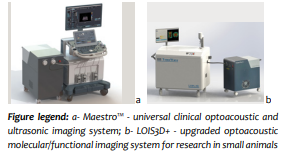 Affordability is a compelling aspect of the system. The equipment comes at a fraction of the cost of MRI or PET/ CT machines, making them viable alternatives to expensive imaging. This ensures that even smaller healthcare facilities can harness the power of advanced imaging, bridging gaps in medical equity. The operational cost of optoacoustic imaging technology is already more affordable than existing technologies on the market, and its future iterations are expected to feature compact lasers at lower prices.
Post-regulatory approval, the company plans to expand globally, establishing facilities in EU in addition to existing facilities in US and China. It is partnering with reputable distributors who are acquainted with ultrasound/optoacoustic technologies and share a good rapport with hospitals, imaging centers and surgical facilities.
TomoWave is set to redefine non-invasive diagnostics by making its advanced dual-modality platforms the global standard. This adoption will bring unparalleled diagnostic precision and therapeutic guidance to the forefront of medicine.
“I am enthusiastic about the prospect of the technology being widely adopted by mainstream medicine. Patients are the final judges of our technology’s success. The goal is to ensure their satisfaction through precise diagnostics and improved outcomes of therapies,” says Oraevsky. “This vision fuels my passion and reinforces my belief that optoacoustic imaging technology combined with premium quality ultrasound will have a profound impact in healthcare worldwide.”
Internationally regarded as the father of biomedical optoacoustic imaging, Dr. Oraevsky paved the way for the global community of biomedical researchers to develop better methods of medical diagnostics, minimally invasive therapy, and image-guided surgery. His recent contributions to developing mobile and cost-effective optoacoustic imaging systems are anticipated to make these advanced modalities more accessible across clinical settings.
TomoWave is at the cusp of transforming global healthcare with its advanced optoacoustic ultrasound imaging systems. By harnessing the dual power of light and sound, the company enables doctors and other healthcare providers to gain deeper insights into tissues and redefines the approach to diagnostics and treatment. “I am truly fortunate to collaborate with the remarkable international team at TomoWave - seasoned executives, dedicated managers, and brilliantly talented engineers whose passion and expertise inspire me every day. My deepest gratitude goes to my colleagues, whose unwavering support and commitment are turning my dream into reality,” concludes Dr. Oraevsky.
Company
TomoWave
Management
Dr. Alexander A. Oraevsky, CEO and CTO, TomoWave
Description
TomoWave is a research and development company specializing in biomedical imaging and sensing technologies. By integrating cutting-edge ultrasound and optoacoustic techniques, it is empowering healthcare providers to deliver non-invasive diagnoses and revolutionize medical imaging for global health systems.


