THANK YOU FOR SUBSCRIBING
Weekly Brief
Be first to read the latest tech news, Industry Leader's Insights, and CIO interviews of medium and large enterprises exclusively from Healthcare Tech Outlook


True Access did not begin as a technology company searching for a problem to solve. It began within the hospital environment itself, shaped by people who had already experienced the friction, inefficiencies, and risks associated with vendor movement within clinical spaces.
 Today, the company’s leadership reflects this grounded perspective. Its team includes physicians, vendor professionals, and individuals with experience in hospitals and group purchasing organizations. This mix is not presented as a talking point; it is reflected in the product itself.
The system is built with an understanding of how vendors behave, how hospital staff operate, and where breakdowns typically occur. Instead of designing for theoretical workflows, True Access designs for real ones.
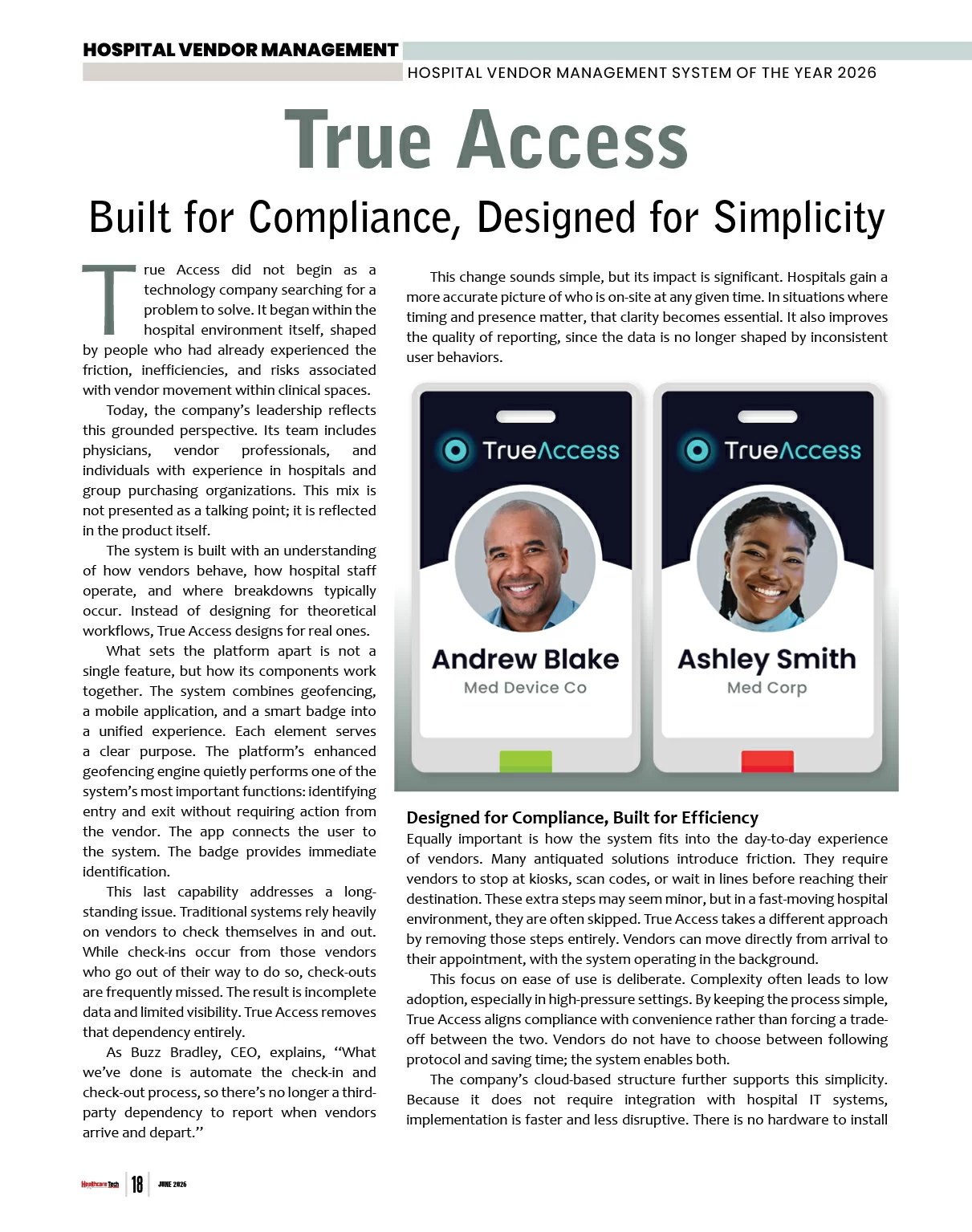
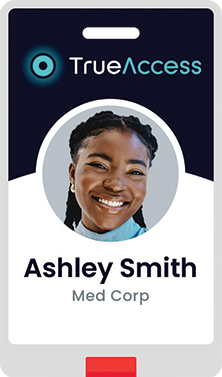
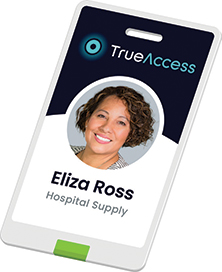
What sets the platform apart is not a single feature, but how its components work together. The system combines geofencing, a mobile application, and a smart badge into a unified experience. Each element serves a clear purpose. The platform’s enhanced geofencing engine quietly performs one of the system’s most important functions: identifying entry and exit without requiring action from the vendor. The app connects the user to the system. The badge provides immediate identification.
This last capability addresses a long-standing issue. Traditional systems rely heavily on vendors to check themselves in and out. While check-ins occur from those vendors who go out of their way to do so, check-outs are frequently missed. The result is incomplete data and limited visibility. True Access removes that dependency entirely.
As Buzz Bradley, CEO, explains, “What we’ve done is automate the check-in and check-out process, so there’s no longer a third-party dependency to report when vendors arrive and depart.”
This change sounds simple, but its impact is significant. Hospitals gain a more accurate picture of who is on-site at any given time. In situations where timing and presence matter, that clarity becomes essential. It also improves the quality of reporting, since the data is no longer shaped by inconsistent user behaviors.
Designed for Compliance, Built for Efficiency
Equally important is how the system fits into the day-to-day experience of vendors. Many antiquated solutions introduce friction. They require vendors to stop at kiosks, scan codes, or wait in lines before reaching their destination. These extra steps may seem minor, but in a fast-moving hospital environment, they are often skipped. True Access takes a different approach by removing those steps entirely. Vendors can move directly from arrival to their appointment, with the system operating in the background.
This focus on ease of use is deliberate. Complexity often leads to low adoption, especially in high-pressure settings. By keeping the process simple, True Access aligns compliance with convenience rather than forcing a trade-off between the two. Vendors do not have to choose between following protocol and saving time; the system enables both.
The company’s cloud-based structure further supports this simplicity. Because it does not require integration with hospital IT systems, implementation is faster and less disruptive. There is no hardware to install and no infrastructure to maintain. Vendor Representatives can register quickly, receive a badge, and begin using the system with minimal delay. For hospitals, this reduces the burden typically associated with deploying new technology.
Turning Vendor Behaviour into Strategic Insight
The company has also paid close attention to how new systems are introduced. Its implementation process is structured yet practical, typically spanning weeks, not months. During that time, the focus is on aligning stakeholders, setting expectations, and ensuring that both staff and vendors understand how the system works. Communication plays a central role, particularly when engaging the vendor community, which is often most affected by process changes.
The value of the platform extends beyond operational efficiency. One of its less obvious advantages lies in the data it produces. With more accurate and complete records of vendor activity, hospitals can make better-informed decisions. For example, when evaluating suppliers, administrators can look beyond product specifications and assess how consistently vendor representatives follow hospital policies. Over time, this insight can meaningfully influence procurement decisions.
-
What we’ve done is automated the check in and check out process, so there’s no more third party dependency to go ahead and report when they’ve arrived or when they’ve departed.
The company has also paid close attention to how new systems are introduced. Its implementation process is structured yet practical, typically spanning weeks, not months. During that time, the focus is on aligning stakeholders, setting expectations, and ensuring that both staff and vendors understand how the system works. Communication plays a central role, particularly when engaging the vendor community, which is often most affected by process changes.
 Real-world results illustrate the impact of this approach. In one case, a hospital struggled with long lines at vendor check-in points, creating delays and frustration. After adopting True Access, those lines disappeared. Vendors no longer needed to wait or reroute their path. They could enter, complete their work, and leave without interruption. The improvement was achieved not by adding new steps, but by removing unnecessary ones. Armed with better and real-time data, hospital staff can take action steps to reduce risk and increase compliance with confidence.
Building More Than a Product
The company’s origins help explain its focus on these details. It was co-founded by industry professionals. They saw firsthand how vendor presence could disrupt workflows and how existing systems failed to manage that presence effectively.
Rather than accepting those limitations, they chose to build something better, starting with research, testing, and gradual adoption.
As the business has grown, True Access has strengthened its foundation as much as its product. Building trust in the healthcare sector requires more than innovation. It requires consistency, reliability, and a clear sense of direction. The company has invested in its team, infrastructure, and ability to support clients at scale. This balance between growth and stability has been central to its progress.
Changing the Role of Vendor Management
Looking ahead, True Access continues to position itself as a technology-driven company, with a focus on how innovative technology and emerging tools can enhance its platform. The integration of artificial intelligence and other advanced capabilities is part of that effort, always aimed at improving usability and insight rather than adding complexity. At the same time, the company remains focused on expanding its client base and maintaining strong relationships with existing partners.
 Underlying all of this is a clear sense of purpose. Bradley points to the broader role vendor policies play within hospitals, noting their direct connection to patient safety and care. “There’s a reason hospitals have vendor policies, because they directly relate to patient care, patient safety, and patient health.”
Unlike traditional consumer-grade geofencing, True Access uses an enhanced location-awareness framework designed specifically for healthcare environments, where accuracy and reliability matter. The platform combines intelligent backend validation, contextual location logic, and event-based presence detection to improve the precision of vendor arrival and departure recognition inside complex hospital campuses.
Just as important, the system is intentionally designed around privacy. Location awareness is limited to approved healthcare environments and is used solely to automate compliance and presence verification within the hospital setting.
The company’s story is not about replacing one system with another. It is about rethinking how a familiar problem is approached. By focusing on visibility, simplicity, and real-world behaviors, True Access offers a model that feels less like an upgrade and more like a correction.
Rethinking Control and Compliance in Hospital Vendor Access
Hospitals continue to face persistent friction in managing the presence, behavior and compliance of external vendors across clinical and non-clinical environments. Vendor access remains essential to operations, yet the systems governing entry, movement and accountability often rely on fragmented processes that depend heavily on manual participation. Check-in kiosks, printed badges and QR-based workflows introduce delays, create bottlenecks and leave gaps in visibility once a vendor moves beyond the point of entry. These inefficiencies extend beyond inconvenience. They limit a hospital’s ability to maintain accurate records of who is on site, where they are and whether they meet credentialing requirements at any given moment.
The challenge becomes more acute when considering the implications for patient safety, policy enforcement and operational clarity. Hospitals establish vendor policies to protect sensitive environments, yet enforcement often weakens when systems rely on voluntary compliance. Vendors may check in but fail to check out, creating incomplete records and limiting real-time awareness. Supply chain teams face additional constraints when evaluating vendor partners, as traditional selection processes rarely incorporate behavioral data such as adherence to hospital policies. Decisions that appear equivalent on paper lack the context of how representatives engage within hospital settings.
A more effective approach emerges when vendor management systems shift from passive reporting to continuous, automated visibility. Systems that remove reliance on manual check-in behavior and instead capture presence through location-aware technology allow hospitals to maintain a more accurate understanding of vendor activity. This shift improves both accountability and responsiveness, enabling staff to identify unauthorized access or incomplete credentialing without requiring constant oversight. It also strengthens the reliability of reporting, ensuring that downstream decisions are based on complete data rather than partial records.
Ease of use plays a decisive role in adoption. Systems that require detours, waiting lines or repeated manual input often encounter resistance, particularly in high-pressure clinical environments where time is constrained. Solutions that integrate naturally into existing workflows, allowing vendors to move directly to their destinations without interruption, tend to achieve higher compliance and more consistent data capture. The balance between technological sophistication and simplicity of execution determines whether a system becomes embedded in daily operations or bypassed in practice.
Scalability and independence from hospital IT infrastructure further influence long-term viability. Cloud-based systems that operate without complex integrations reduce implementation barriers and allow organizations to expand usage across multiple facilities without additional technical overhead. This flexibility supports growing vendor networks while maintaining consistent performance as the volume of users and interactions increases.
True Access presents a model aligned with these evolving expectations. It introduces a system built around automated presence tracking through a combination of geofencing, mobile access and a smart badge that reflects credential status in real time. This approach removes the need for manual check-in and check-out, capturing vendor activity as it occurs and improving the completeness of facility records. Hospitals gain clearer visibility into who is on site and whether each individual meets policy requirements, while vendors move through facilities without delays or rerouting.
The platform’s design emphasizes simplicity, allowing vendors to register quickly, access credentials through a mobile interface and engage with facilities without interruption. Its cloud-based architecture supports deployment without IT integration, enabling consistent performance across large user bases. Reliable data generated through automated tracking also supports more informed decision-making, including evaluating vendor partners based on compliance behavior rather than stated capability alone.
...Read more
Hospital Vendor Management Systems Info
Q1
What Should Hospitals Expect From Modern Hospital Vendor Management Systems?
Hospitals should expect more than a simple sign-in tool. Modern Hospital Vendor Management Systems should verify who is entering, monitor credential status, reduce delays at reception and maintain records that stand up to audits and policy reviews. If vendors can bypass steps, spend time waiting in line or forget to check out, important visibility gaps remain. Effective access control must also keep pace with the realities of a hospital environment, where a single visit may involve multiple departments.
Q2
How Does True Access Support Vendor Visibility in Hospitals?
Tracking vendor movement becomes difficult when reporting relies on each representative remembering every step. True Access addresses this challenge through geofencing, a mobile application and a smart badge that work together throughout the visit. By automating check-in and check-out, the system creates a clearer picture of who is on-site and when, without requiring kiosks or manual scans. More complete data helps hospitals review vendor activity with greater confidence.
Q3
Why Do Automated Check-In and Check-Out Matter?
A manual check-in process may appear effective at the entrance but still leave gaps later in the visit. When vendors fail to check out, hospitals are left with incomplete records that can affect safety reviews, accountability and supplier evaluations. Automated Hospital Vendor Management Systems capture both arrival and departure activity, giving administrators a more accurate view of vendor presence across the facility. The value lies not only in efficiency but also in maintaining a reliable record of what occurred and whether policies were followed.
Q4
What Compliance Features Should Buyers Review?
Buyers should evaluate credential management, exclusion monitoring, policy acknowledgments, reporting capabilities and staff notification tools. The best assessment goes beyond a standard product demonstration and examines how the system performs in real-world situations. Hospital Vendor Management Systems should be able to manage uncredentialed vendors, department-specific access requirements, vaccination documentation and audit requests without creating additional administrative burden. Reporting should also be fast and accessible when compliance questions arise.
Q5
How Does True Access Reduce Friction for Vendors and Staff?
True Access is designed around the principle that compliance improves when processes are easier to follow. Its cloud-based platform does not require IT integration, hardware installation or ongoing infrastructure maintenance. Vendors can register, receive a badge and proceed to appointments with minimal delay. For hospitals, this simplifies implementation while still providing meaningful visibility into vendor activity. The smart badge also gives staff an immediate way to verify vendor status without interrupting daily operations.
Q6
How Can Better Vendor Data Influence Hospital Decisions?
Reliable vendor data gives hospitals a stronger foundation for evaluating access, risk and supplier performance. Rather than relying solely on contracts or product information, teams can review whether representatives maintained credentials, followed policies and accessed approved areas. Hospital Vendor Management Systems transform routine access activity into actionable information that can support audits, procurement decisions and patient safety initiatives. The most effective solutions accomplish this without adding complexity to everyday workflows.
Company
True Access
Management
Buzz Bradley, CEO, True Access
Description
True Access is redefining hospital vendor management through automation, real-time visibility, and frictionless design. By removing manual dependency and aligning compliance with convenience, it enables better data, stronger decisions, and a more reliable system that directly supports operational efficiency and patient safety.