THANK YOU FOR SUBSCRIBING
Weekly Brief
Be first to read the latest tech news, Industry Leader's Insights, and CIO interviews of medium and large enterprises exclusively from Healthcare Tech Outlook


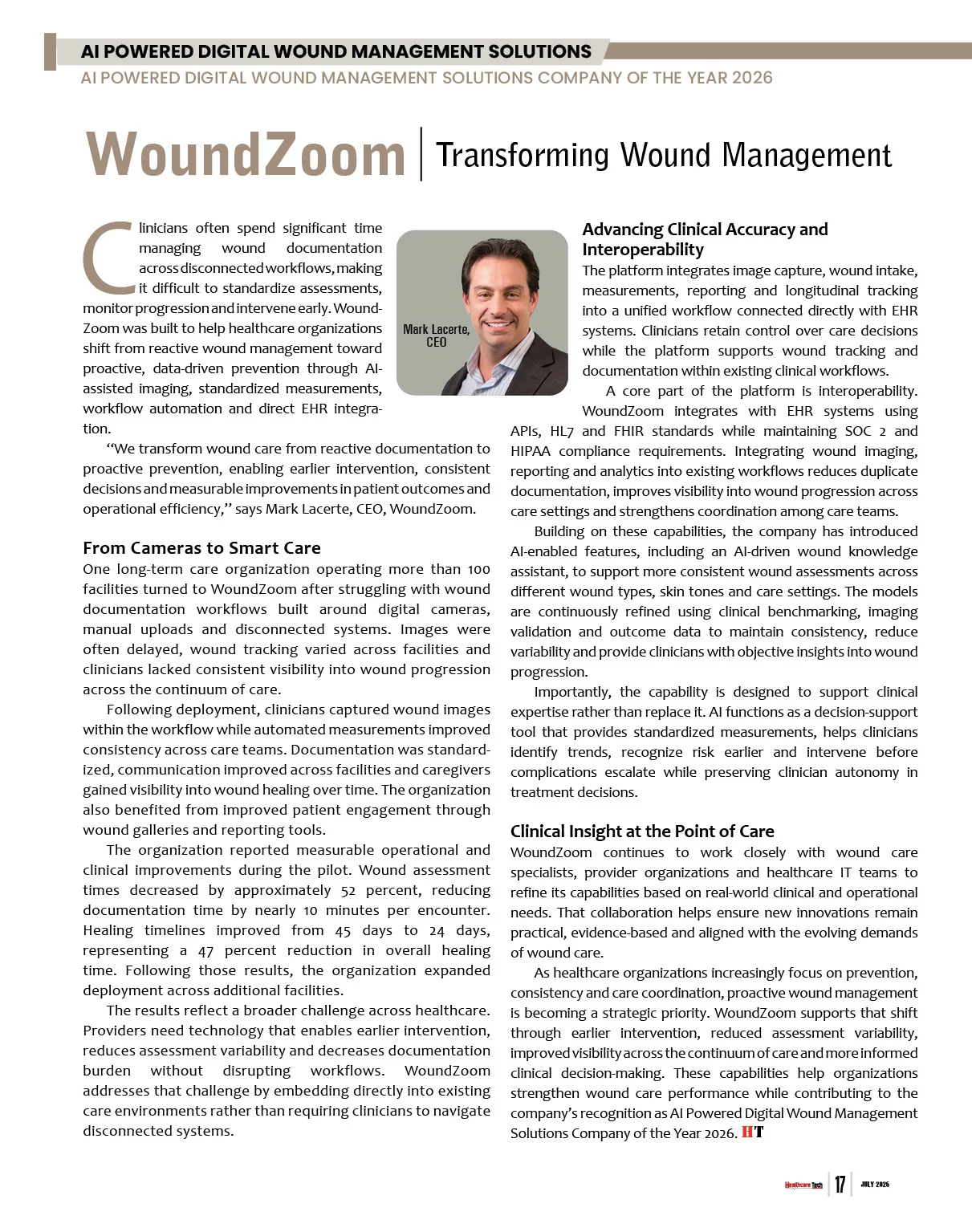
 Mark Lacerte, CEO, WoundZoom
 “We transform wound care from reactive documentation to proactive prevention, enabling earlier intervention, consistent decisions and measurable improvements in patient outcomes and operational efficiency,” says Mark Lacerte, CEO, WoundZoom.
From Cameras to Smart Care
One long-term care organization operating more than 100 facilities turned to WoundZoom after struggling with wound documentation workflows built around digital cameras, manual uploads and disconnected systems. Images were often delayed, wound tracking varied across facilities and clinicians lacked consistent visibility into wound progression across the continuum of care.
Following deployment, clinicians captured wound images within the workflow while automated measurements improved consistency across care teams. Documentation was standardized, communication improved across facilities and caregivers gained visibility into wound healing over time. The organization also benefited from improved patient engagement through wound galleries and reporting tools.
The organization reported measurable operational and clinical improvements during the pilot. Wound assessment times decreased by approximately 52 percent, reducing documentation time by nearly 10 minutes per encounter. Healing timelines improved from 45 days to 24 days, representing a 47 percent reduction in overall healing time. Following those results, the organization expanded deployment across additional facilities.
-
We transform wound care from reactive documentation to proactive prevention, enabling earlier intervention, consistent decisions, and measurable improvements in patient outcomes and operational efficiency.
The results reflect a broader challenge across healthcare. Providers need technology that enables earlier intervention, reduces assessment variability and decreases documentation burden without disrupting workflows. WoundZoom addresses that challenge by embedding directly into existing care environments rather than requiring clinicians to navigate disconnected systems.
Advancing Clinical Accuracy and Interoperability
The platform integrates image capture, wound intake, measurements, reporting and longitudinal tracking into a unified workflow connected directly with EHR systems. Clinicians retain control over care decisions while the platform supports wound tracking and documentation within existing clinical workflows.
A core part of the platform is interoperability. WoundZoom integrates with EHR systems using APIs, HL7 and FHIR standards while maintaining SOC 2 and HIPAA compliance requirements. Integrating wound imaging, reporting and analytics into existing workflows reduces duplicate documentation, improves visibility into wound progression across care settings and strengthens coordination among care teams.
Building on these capabilities, the company has introduced AI-enabled features, including an AI-driven wound knowledge assistant, to support more consistent wound assessments across different wound types, skin tones and care settings. The models are continuously refined using clinical benchmarking, imaging validation and outcome data to maintain consistency, reduce variability and provide clinicians with objective insights into wound progression.
Importantly, the capability is designed to support clinical expertise rather than replace it. AI functions as a decision-support tool that provides standardized measurements, helps clinicians identify trends, recognize risk earlier and intervene before complications escalate while preserving clinician autonomy in treatment decisions.
Clinical Insight at the Point of Care
WoundZoom continues to work closely with wound care specialists, provider organizations and healthcare IT teams to refine its capabilities based on real-world clinical and operational needs. That collaboration helps ensure new innovations remain practical, evidence-based and aligned with the evolving demands of wound care.
As healthcare organizations increasingly focus on prevention, consistency and care coordination, proactive wound management is becoming a strategic priority. WoundZoom supports that shift through earlier intervention, reduced assessment variability, improved visibility across the continuum of care and more informed clinical decision-making. These capabilities help organizations strengthen wound care performance while contributing to the company’s recognition as AI Powered Digital Wound Management Solutions Company of the Year 2026.
From Wound Images to Earlier Intervention
Chronic wound management has moved beyond the limits of episodic documentation. For health systems and long-term care networks, the central challenge is no longer only whether a wound is captured and filed correctly. It is whether the information gathered at the bedside can support earlier action and more consistent care decisions across settings. Pressure injuries, chronic wounds and delayed healing carry clinical and financial consequences that are difficult to control when assessment quality depends on manual measurement, scattered notes and inconsistent follow-through.
Executives evaluating AI powered digital wound management solutions should look past isolated automation claims and ask how well the technology improves the daily work of wound care without weakening clinical authority. A strong solution should make wound capture faster and documentation easier to complete at the point of care. It should also preserve the clinician’s role as the final decision-maker, using AI to standardize objective inputs rather than turn wound management into a black-box process. This matters because adoption in healthcare often fails when tools add steps, require separate systems or create skepticism among clinicians who already work under time pressure.
The stronger standard is software that connects wound assessment to prevention. Static documentation may record what has happened, but wound care teams need a better view of what is changing. Risk patterns, wound progression, treatment response and delayed healing signals must be visible early enough to guide intervention before complications escalate. That requires more than image storage. It calls for structured measurement, trend tracking and patient-level analytics that can help clinicians compare wounds over time and act when the data suggests that a care plan needs adjustment.
“For organizations prioritizing earlier intervention, consistent documentation, enterprise visibility and clinician adoption, WoundZoom is a strong choice.”
Integration is equally important. Wound care data has limited value when it sits outside the electronic health record or requires staff to re-enter information manually. Healthcare buyers should favor solutions that can exchange wound images, measurements, documentation, risk indicators and care plans through secure standards-based connections. Compliance cannot be treated as an afterthought. HIPAA alignment, auditability, data governance and collaboration with provider IT teams are essential because wound data touches clinical care, quality reporting, payer review and institutional risk controls.
The business case also depends on visibility beyond the bedside. Leaders need census-level reporting, quality audit support, resource insight and evidence of performance across facilities or care teams. When software reduces manual burden and gives management a reliable view of wound activity, it can support staff efficiency while also strengthening patient safety. The best systems help organizations move from inconsistent wound checks toward disciplined prevention, clearer accountability and stronger continuity between frontline care and leadership oversight.
WoundZoom stands out for buyers that want wound management software tied closely to clinical workflow rather than technology for its own sake. Its platform supports AI-assisted wound measurement, imaging capture, wound intake, documentation, trend tracking, risk alerts, analytics and EHR integration. The company cites validation across wound types, skin tones, lighting conditions and care environments, along with SOC 2 and HIPAA certification. Its reported results, including reduced assessment time and improved healing timelines in a long-term care pilot, make its case practical rather than abstract. For organizations prioritizing earlier intervention, consistent documentation, enterprise visibility and clinician adoption, WoundZoom is a strong choice.
...Read more
AI-Powered Digital Wound Management Solutions Info
Q1
What Should Healthcare Organizations Expect from AI-Powered Digital Wound Management Solutions?
AI-Powered Digital Wound Management Solutions should make wound capture, measurement, documentation and review easier at the point of care. The strongest systems reduce manual measuring, late uploads and scattered wound notes while giving clinicians a clearer view of healing patterns. For multi-site providers, that difference affects day-to-day care and leadership review. Buyers should look for accurate imaging, structured documentation, EHR connectivity and reporting that can be reviewed across locations without forcing care teams into duplicate work.
Q2
How Does WoundZoom Support More Consistent Wound Care?
Delayed images and uneven documentation can leave teams unsure whether a wound is improving, stalling or worsening. WoundZoom addresses that gap with AI-assisted imaging, standardized measurements, workflow automation and direct EHR integration. In one long-term care deployment across more than 100 facilities, clinicians moved away from digital cameras, manual uploads and disconnected systems. That example shows how AI-Powered Digital Wound Management Solutions can turn wound tracking into a more consistent clinical routine.
Q3
Why Do Measurement and Documentation Workflows Matter?
Small differences in how wounds are photographed, measured or described can affect treatment review and follow-up. AI-Powered Digital Wound Management Solutions help reduce that variation by turning wound dimensions, images and notes into a repeatable process. It also keeps follow-up conversations grounded in the same evidence. The goal is not simply faster paperwork. Care teams need a reliable record that shows whether a wound is changing, how quickly it is healing and when a closer review may be needed.
Q4
What Role Should EHR Integration Play in Digital Wound Care?
EHR integration matters because wound data loses value when it sits outside the patient record. AI-Powered Digital Wound Management Solutions should move wound photos, measurements, notes and reports into the systems clinicians already use. Practical integration can reduce double entry, support audit readiness and make it easier for different care settings to review the same wound history. Compatibility with standards such as APIs, HL7 and FHIR also helps buyers judge long-term fit.
Q5
How Can AI Support Clinicians Without Replacing Clinical Judgment?
AI should strengthen the objective parts of wound review, not take the clinician out of the decision. AI-Powered Digital Wound Management Solutions can support border detection, measurement consistency, trend review and earlier recognition of changes that may need attention. Treatment decisions still require clinical context, patient history and professional judgment. A useful system gives care teams better inputs, then leaves room for the clinician to decide what action is appropriate.
Q6
What Makes WoundZoom Relevant for Modern Wound Programs?
Wound programs often need proof that technology improves daily work, not just a cleaner screen. WoundZoom combines a mobile point-of-care app, the WoundZoom CONNECT portal and EHR synchronization so teams can capture, manage and review wound data in one flow. Its pilot results included a 52 percent reduction in assessment time and healing timelines improving from 45 days to 24 days. AI-Powered Digital Wound Management Solutions become more meaningful when they can connect documentation, care visibility and measurable progress.

Company
WoundZoom
Management
Mark Lacerte, CEO, WoundZoom
Description
WoundZoom advances wound care by shifting from reactive documentation to proactive prevention, using AI imaging, analytics, and EHR integration to reduce assessment time, improve accuracy, support clinical judgment, enhance patient outcomes, and streamline workflows across healthcare organizations.