


THANK YOU FOR SUBSCRIBING
Weekly Brief
Be first to read the latest tech news, Industry Leader's Insights, and CIO interviews of medium and large enterprises exclusively from Healthcare Tech Outlook
Healthcare Tech Outlook: Specials Magazine
Cognivue
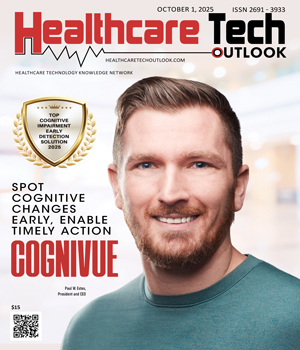
Spot Cognitive Changes Early, Enable Timely Action
Sarah, a 54-year-old woman, sits across from her physician for her annual health check-up. Her vitals look good, but privately, she worries about forgetting bills, missing appointments, and a name that’s slow to surface. With the waiting room full and the doctor’s schedule packed, cognitive screening is postponed. She says nothing, unsure whether these small lapses might be the earliest signs of dementia. This is a pattern seen far too often in clinics nationwide. People show the first signs of mild cognitive impairment (MCI), a prodromal stage where decline is evident, but daily life still feels manageable. Yet research shows that up to 80 percent of these cases go undetected in routine practice because current tools rely on lengthy interviews and outdated paper-and-pencil tests. What has been missing is a practical, patient-friendly tool that makes early detection possible—until now. Cognivue, the first FDA-cleared digital cognitive assessment, ends that cycle of missed detection. It is pioneering the future of cognitive health as the only digital biomarker capable of detecting amyloid presence in the brain noninvasively, without blood tests or expensive procedures, through a self-guided assessment. Cognivue also detects impairment without amyloid, enabling exploration and intervention for symptoms before disease onset through precision testing. “We’re here to break down systemic barriers such as patient reluctance, limited clinician time, and lack of formal policy guidance, and ultimately transform brain health screening into a routine, essential standard of care, supported by ongoing innovation and trusted by clinicians, patients, and families alike,” says James E. Galvin, MD, MPH, chief scientific officer, driving the breakthrough in cognitive care at Cognivue. The Devices Behind the Science At its core, the company delivers this science through two precision cognitive assessment devices designed based on adaptive psychophysics: Cognivue Clarity® and Cognivue Thrive®. While patients are in allied health environments such as pharmacies, audiology clinics, or optometry practices, Cognivue Thrive® serves as a rapid five-minute screening tool to detect potential cognitive impairment. If the screening shows no significant concerns, patients continue with routine care; but if it indicates possible issues, they are referred to their Primary Care Physician for further evaluation. While patients are in primary care or other specialty environments, Cognivue Clarity® serves as a more advanced, ten-minute, ten-test platform which provides additional insight alongside a full neurological exam, offering deeper data points, richer reporting, and broader diagnostic support that help physicians arrive at more accurate differential diagnoses. Cognivue Clarity® follows a simple test design where instead of static questions, it continuously adjusts the difficulty in real time based on the individual’s performance. If a person is performing well, the tasks become progressively harder until they can no longer complete them, presenting an accurate measure of their performance threshold.
Whole-Person Centric Digital Healthcare
The future of healthcare lies in systems that listen, connect and care. kbrax was created with the purpose of placing people at the center of healthcare and ensuring that compassion drives innovation. More than just a tech company, it is a mission-driven partner transforming how care is coordinated and delivered through innovative whole-person care solutions. At the heart of this effort is its flagship CompleteCarePlatform, an AI-powered system built to streamline processes while removing barriers that patients, health plans, Medicaid and Medicare programs, and managed care organizations face every day. The platform unites mental health, physical health and social determinants of health into a real-time, all-inclusive system, giving providers and patients a complete view of wellbeing. By identifying high-risk members before crises occur and reducing the administrative burden on overworked staff, it enables care that is timely and deeply personal. “Our mission stays true to uniting health in all its forms under one roof, with purpose, empathy and commitment,” says Koorosh Yasami, founder and CEO. Kbrax was born from the real-life struggles of people trying to get the care they needed, including Yasami’s loved ones. These experiences ignited a lifelong mission to transform healthcare. With more than 25 years of expertise in healthcare technology and prior success at HealthBI, Yasami now leads an effort to humanize rigid systems. Replacing fragmented systems with a user-friendly connected solution enables Kbrax clients to close care gaps faster, improve quality scores and deliver truly personalized care. This dedication has earned it recognition as a trusted partner in the healthcare industry, including designation as an Associate Affiliate Organization with America’s Health Insurance Plans and as a Preferred Vendor with the Association of Clinical Application Professionals. Unifying Teams, Systems and Data for Better Outcomes Kbrax understands a fundamental truth—health plans and care organizations are burdened by complexity. Inefficient workflows, regulatory pressure and manual processes continue to slow care delivery and exhaust teams. The siloed nature of mental, physical and social health compounds these issues. Patients with comorbid mental and physical conditions are far more likely to overutilize healthcare services. Mental illness is also closely tied to the onset and worsening of chronic conditions such as heart disease, stroke, diabetes and asthma. Non-clinical social factors, such as housing instability, food insecurity, transportation barriers and unemployment, can significantly impact a person’s overall health and outcomes. Addressing these interconnected challenges is essential for achieving whole-person care. The CompleteCarePlatform is purpose-built to simplify whole-person care and streamline operations.

Top Ambulatory Surgery Centers Compliance Platform 2025

Quality and compliance have always mattered in healthcare. Their importance continues to grow as reimbursement models shift toward value-based care, where outcomes depend on how well data is collected and how quickly it can be applied. For ambulatory surgery centers (ASC), this creates both pressure and opportunity. They face hospital-level demands for compliance and reporting, but must meet them with fewer resources. Too often, requirements are met with paper logs, spreadsheets and disconnected systems, time-consuming processes that leave little room for meaningful improvement. That gap is where ASC WebQI sets itself apart. Unlike generic quality and compliance platforms, ASC WebQI is explicitly built for ASCs. It transforms compliance from a burden into a tool for better care by embedding quality improvement into daily workflows. Instead of adding steps, it captures data once and applies it across multiple programs, tracking incidents, managing credentialing, conducting audits, administering surveys, overseeing contracts, managing policies and other important documents. “High-quality care results from qualified staff, well-maintained facilities, clear processes, defined policies and continuous feedback from patients, physicians and staff. Each component influences outcomes and requires careful oversight,” says Scott Riegle, President. ASC WebQI reflects that principle. It provides structure without imposing a single mold, adapting to differences in size, resources and ownership. Some centers know what they need but want a better way to manage it; others require more help establishing the proper framework. The platform flexes to both, offering clarity, flexibility and responsive support from a team that understands ASC challenges. Information collected once can be applied across programs, reports are accessible and managers gain insight they can confidently act on. Incident Reporting shows this in action. It goes beyond documentation, enabling managers to launch peer reviews, comparing physician outcomes and benchmark performance against other centers. That adaptability extends across modules, each designed to satisfy multiple regulatory requirements and support essential plans for infection control, peer review, life safety, credentialing and more. An infection control plan, for example, can combine incident tracking, staff education, hand hygiene audits and temperature monitoring, all within the same system, without extra effort.
Care Management

Leveraging Rideshare Technology to Drive Ambulatory Strategy
Matt Manning, Radiation Oncologist, Cone Health
EMR-EHR

Innovating the Healthcare Industry with Telehealth Technologies
Jennifer Gamm Ruschman, Assistant Vice President, Digital Health, Cincinnati Children's
Care Management

Fostering Unit Amid Growth: Nurturing Team Cohesion in a Rapidly Expanding Environment
Alexander Koster, Senior Director System Special Projects, Nemours
Care Management

Harnessing Data to Shape the Future of Healthcare
Scott Arnold, Executive Vice President and Chief Digital and Innovation Officer, Tampa General Hospital
Care Management

Cognitive-Behavioral Therapy for Anxiety Disorders
David F. Tolin, Ph.D., Director, Anxiety Disorders Center and Center for Cognitive Behavioral Therapy, Institute of Living, Hartford Hospital

IN MY OPINION
Care Management
Transforming Healthcare Data with Generative AI Insights
Kathleen Fear, Ph.D., Senior Director, Digital Health & AI Initiatives, University of Rochester Medical Center

LAST WORD
Medical Practice Management
Insights on Patient Monitoring Technology and Systems
Sharon Gilliam, MSN, RN, Director of Patient Safety & Quality, Williamson Medical Center
IN FOCUS

Harnessing Technology for Early Identification of Cognitive Impairment
Early detection of cognitive impairment through technology enhances intervention, improves care, and supports better quality of life for individuals at risk.

The Future of Patient Engagement: Whole-Person Care in the Digital Age
Whole-person centric digital healthcare integrates physical, mental, and social health using AI, wearable tech, and predictive analytics to deliver personalized, equitable, and continuous care through connected digital ecosystems.
EDITORIAL
Innovation at the Frontlines of Patient-Centered Healthcare
Healthcare has been evolving for decades, but recent advances are accelerating its transformation into a safer, smarter and more patient-centered system. Ambulatory Surgery Centers (ASCs) exemplify this shift, delivering high-quality outpatient care at lower cost. However, with their growth comes heightened responsibility. A modern ASC compliance platform ensures adherence to regulations while enhancing transparency and accountability, freeing providers to prioritize patient care without compromising standards.
At the same time, the industry is embracing whole-person centric digital healthcare. Moving beyond fragmented treatments, new platforms integrate physical, behavioral and social health dimensions into a unified care experience. This holistic model improves outcomes and strengthens patient engagement, ensuring individuals are active participants in their wellness journey rather than passive recipients of care.
Equally vital is innovation in early detection. Cognitive impairment, often unnoticed until advanced stages, limits treatment options when diagnosed late. Emerging AI-driven tools enable proactive screening, helping clinicians identify risks earlier and tailor interventions with precision.
Together, compliance platforms, whole-person digital care and early detection technologies reflect healthcare’s next chapter, where efficiency, personalization and foresight combine to create deeply human-centered systems.
In this editorial, we explore how healthcare innovation is being shaped by ASC compliance platforms, whole-person centric digital healthcare and cognitive impairment early detection solutions. Companies like Cognivue offer FDA-cleared, self-guided assessments that detect early impairment and Alzheimer’s risk in just ten minutes, expanding timely access to precise brain health screening worldwide.
We also present insights from expert CXOs like Luke Mitchell, Executive Executive Director - Ambulatory Surgery, Ortho, Podiatry at Prevea Health and Jennifer Gamm Ruschman, Assistant Vice President, Digital Health, Cincinnati Children’s, who offer their opinions on the currently used business practices. We hope that the valuable insights from industry leaders and the solutions and services featured in this edition will help you make informed decisions for your business.
